
The Chinese Exclusion Act: Chapter 1
Clip: Season 30 | 9m 16sVideo has Closed Captions
Watch Chapter 1 of The Chinese Exclusion Act.
Examine the origin, history and impact of the 1882 law that made it illegal for Chinese workers to come to America and for Chinese nationals already here ever to become U.S. citizens.
Problems playing video? | Closed Captioning Feedback
Problems playing video? | Closed Captioning Feedback
Corporate sponsorship for American Experience is provided by Liberty Mutual Insurance and Carlisle Companies. Major funding by the Alfred P. Sloan Foundation.
Support provided by:


The Chinese Exclusion Act: Chapter 1
Clip: Season 30 | 9m 16sVideo has Closed Captions
Examine the origin, history and impact of the 1882 law that made it illegal for Chinese workers to come to America and for Chinese nationals already here ever to become U.S. citizens.
Problems playing video? | Closed Captioning Feedback
Where to Watch American Experience
American Experience is available to stream on pbs.org and the PBS app.
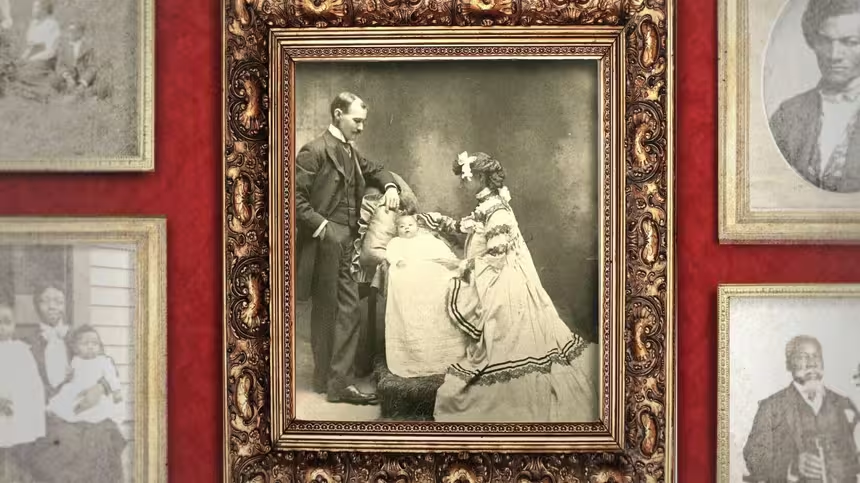
When is a photo an act of resistance?
For families that just decades earlier were torn apart by chattel slavery, being photographed together was proof of their resilience.Providing Support for PBS.org
Learn Moreabout PBS online sponsorship(birds squawking) ♪ ♪ NARRATOR: On June 30, 1885, as the fund-raising campaign for the pedestal of the Statue of Liberty finally began to pick up speed, a letter appeared in the pages of "The New York Sun" written by a young Chinese immigrant and recent college graduate named Saum Song Bo, who had come to America years earlier as a small boy, and who dreamed of becoming a lawyer.
SAUM SONG BO (dramatized): "Sir: A paper was presented to me yesterday "for subscription among my countrymen "toward the Pedestal Fund of the Statue of Liberty.
"My countrymen and myself are honored "in being thus appealed to "as citizens in the cause of liberty.
"But the word liberty makes me think of the fact "that this country is the land of liberty "for all men of all nations except the Chinese.
"That statue represents Liberty holding a torch-- "which lights the passage "of those of all nations who come into this country.
"But are the Chinese allowed to come?
"Are the Chinese here allowed to enjoy liberty "as men of all other nationalities enjoy it?
"Free from the insults, abuse, assaults, wrongs, and injuries "from which men of other nationalities are free?
"By the law of this nation, "a Chinaman cannot become a citizen.
"Whether this statute against the Chinese "or the Statue of Liberty "will be the more lasting monument to tell future ages "of the liberty and greatness of this country "will be known only to future generations.
Saum Song Bo."
(distant voice speaking Chinese dialect) (bell tolling) (horse whinnying) NARRATOR: The solitary arm of the unfinished Statue of Liberty had languished on Madison Square in New York for more than five years when on May 6, 1882-- on the eve of the greatest wave of immigration in American history-- President Chester A. Arthur signed into law an extraordinary piece of federal legislation.
It was called the Chinese Exclusion Act-- and it was unlike any law enacted since the founding of the Republic.
Singling out as never before a specific race and nationality for exclusion, it made it illegal for Chinese workers to come to America and for Chinese nationals already here ever to become citizens of the United States.
Fueled by deep-seated tensions over race and class and national identity that had been festering since the founding of the Republic, it was the first in a long line of acts targeting the Chinese for exclusion-- and it would remain in force for more than 60 years.
It continues to shape the debate about what it means to be an American to this day.
(seagull squawking) RENQIU YU: Chinese Americans always have this identification with the founding principle of this country, so beautifully laid out by the Founding Fathers and so eloquently articulated in the Declaration of Independence and the American Constitution.
The Chinese identify with this fundamental principle of liberty, equality, and justice for all, and all men are created equal.
Now, how can you say that this is a group of people who are biologically and culturally unfit to live a civilized life, to appreciate and practice American culture, political and religious ideals.
That's why I think a lot of Americans had a hard time to learn that the Chinese Exclusion Act really exists for 60 years.
They couldn't believe it, the government did that.
MAE NGAI: We have to remember that for most of the 19th century, immigration into the United States was basically open.
You just showed up.
So the Chinese exclusion law is one of the first really comprehensively restrictive laws.
And it's also the first and only time in the entire history of the United States that a group is singled out by name-- Chinese, by name-- as being undesirable.
So this is truly a remarkable moment.
JEAN PFAELZER: Starting in California, the Chinese were marked as different.
And I see the 1882 bill as a link in a chain of bills and a chain of legislation, and race riots and purges that are trying to move the country toward ethnic cleansing.
The 1882 bill was not about labor.
I think it was about white purity, and, "How do we get rid of people who were different?"
DAVID LEI: Many people think of this exclusion law as being very racist, very unfair.
But if you look at the world at that time-- every country was like that, and almost every ethnicity.
Try to be a citizen of China, or try to be a citizen of Japan, is impossible unless you're ethnically Chinese or Japanese.
But this is a group of people-- Chinese-American, the Chinese that were here-- who actually fought back and made America better than what it was, and helped make America what it is today-- the values that we have, including equal protection under the law; rights to education; what it means to be American, what makes you American, to be born here.
All these weren't defined.
JOHN KUO WEI TCHEN: The 1882 exclusion law has been forgotten.
But once we remember it, it is outrageous.
And it's probably why we've forgotten it, because it is so outrageous.
Many Americans today cannot believe this happened.
How could this country-- in its culture, in its politics, in its economics-- do what it did against a whole class of people?
The exclusion law said, "That whole race of people are banned from this country."
So it's a racial exclusion law.
So that banning of a whole category of people directly challenges foundational questions of what American freedom means, and what American history means, who "We the people" can constitute.
K. SCOTT WONG: I think it's essential that Americans know about the exclusion of Chinese-- not because it's the Chinese, but because it reflects how America has come to develop, how America saw itself at one time, and how it continues to see itself.
It has much to do with the character of our national history.
And that, to me, is the most important thing in understanding how we became who we are today.
Some of it has to do with the fact that we excluded Chinese for 60 years.

Harry Houdini's Impulse to Escape
Clip: S30 | 1m 38s | Harry Houdini's impulse to escape dangerous situations attracted thousands of spectators. (1m 38s)

Genetic Screening: Controlling Heredity
Video has Closed Captions
Clip: S30 | 11m 12s | The ability to prevent suffering through genetic screenings sparks difficult questions. (11m 12s)
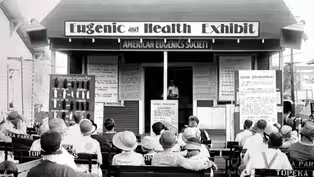
Video has Closed Captions
Preview: S30 | 30s | The shocking history of the early 20th-century campaign to breed a “better” American race. (30s)
The Eugenics Crusade: Chapter 1
Video has Closed Captions
Clip: S30 | 8m 38s | Watch Chapter 1 of The Eugenics Crusade. (8m 38s)
Clip: S30 | 1m 19s | Besides inventing Corn Flakes, John Kellogg helped promote the American Eugenics movement. (1m 19s)
P.G. Lowery and the Spread of African-American Music
Clip: S30 | 2m 47s | P.G. Lowery’s all-black band gained early twentieth century fame through the circus. (2m 47s)
Video has Closed Captions
Clip: S30 | 9m 32s | The Circus, Part 2: Chapter 1 (9m 32s)
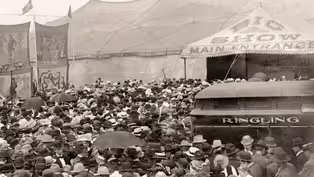
Clip: S30 | 30s | Revisit the heyday of America’s traveling circus and meet the showmen who created it. (30s)
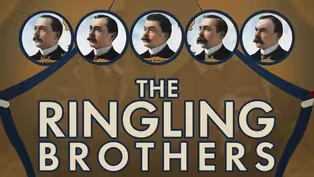
Clip: S30 | 1m 14s | The Ringling Brothers expanded from a tiny regional circus to this large traveling circus. (1m 14s)
Clip: S30 | 1m 23s | Phineas Taylor Barnum, properly known as P.T. Barnum, was a showman. (1m 23s)
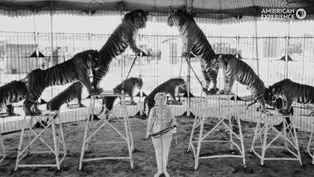
Clip: S30 | 1m 23s | Mable Stark was one of the 20th century's most famous cat trainers. (1m 23s)
Clip: S30 | 1m 21s | The sale of Jumbo, the African elephant to P.T. Barnum causes an uproar in England. (1m 21s)
Preview: S30 | 30s | Explore the history of this popular, influential and distinctly American form of entertain (30s)
Video has Closed Captions
Clip: S30 | 9m 22s | Watch Chapter 1 of The Circus. (9m 22s)
Clip: S30 | 30s | Explore the early days of this popular, influential and distinctly American form of entert (30s)
The Circus | Coming October 2018
Preview: S30 | 1m | "The Circus" explores the history of this distinctly popular American entertainment. (1m)
Clip: S30 | 1m 25s | In 1910, Charles Davenport founded Eugenics Record Office to collect human heredity data. (1m 25s)
Clip: S30 | 8m 32s | Explore today's social circus movement through the eyes of Sidney “Iking” Bateman. (8m 32s)
Eugene O'Neill: Playwright and Nobel laureate
Clip: S30 | 2m 21s | Pulitzer prize winner & Nobel laureate, Eugene O’Neill revolutionized the American stage. (2m 21s)
Clip: S30 | 2m 31s | Seemingly impervious to injury or illness, Yankee slugger Lou Gehrig never missed a game. (2m 31s)
Clip: S30 | 2m 6s | In 2001, George H.W. Bush wrote a letter for history, addressed to his children. (2m 6s)

Hoops and Laughter: The Harlem Globetrotters
Clip: S30 | 3m 33s | A team of African American basketball players from Chicago began touring the Midwest as tc (3m 33s)

Preview: S30 | 20s | After his brother was assassinated, Robert F. Kennedy struggled to find his voice. (20s)
Clip: S30 | 2m 32s | On April 4, 1968, RFK delivered the news of Dr. King’s assassination in Indianapolis. (2m 32s)
Video has Closed Captions
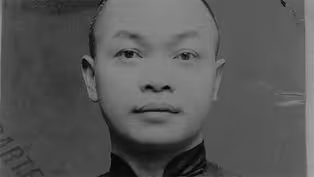
Clip: S30 | 2m 39s | In 1898, the Supreme Court ruled that Wong Kim Ark had acquired U.S. citizenship at birth. (2m 39s)
Clip: S30 | 35s | In 1882, President Chester A. Arthur signed into law the Chinese Exclusion Act. (35s)
The Chinese Exclusion Act: Promo
Preview: S30 | 30s | On May 6, 1882, President Chester A. Arthur signed into law The Chinese Exclusion Act. (30s)
The Chinese Exclusion Act: Preview
Preview: S30 | 3m 18s | Watch a preview of The Chinese Exclusion Act. (3m 18s)
 Now Playing
The Chinese Exclusion Act: Chapter 1
Video has Closed Captions
Clip: S30 | 9m 16s | Watch Chapter 1 of The Chinese Exclusion Act. (9m 16s)
Clip: S30 | 2m 1s | In April 1933, the Barrow gang holed up in Joplin, Missouri for a break from the road. (2m 1s)
Clip: S30 | 2m 26s | In 1925, the “Scopes Monkey Trial” pit traditional Christian beliefs against evolution. (2m 26s)
Clip: S30 | 1m 13s | Max Schmeling convinced the U.S. Olympic Committee to attend the 1936 Olympic games. (1m 13s)
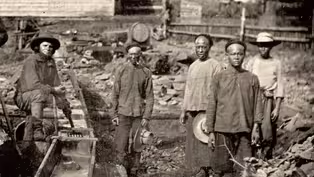
PBS Previews: The Chinese Exclusion Act
Video has Closed Captions
Preview: S30 | 1m 30s | Get an inside look at the making of The Chinese Exclusion Act, premiering May 29 at 8/7c. (1m 30s)

Clip: S30 | 50s | The Hawaiian people had done everything in their power not to be annexed by the U.S. (50s)

Preview: S30 | 30s | A young Navy wife made a drastic rape allegation against five nonwhite Hawaiians in 1931. (30s)
Video has Closed Captions
Clip: S30 | 9m 19s | The Island Murder: Chapter 1 (9m 19s)

First White Settlers in Hawai’i
Clip: S30 | 1m 8s | The first white Americans to settle in the Islands arrived in the 1820s. (1m 8s)
Clip: S30 | 5m 33s | Who is this? Our team turned to Facebook, then headed to Memphis to find out. (5m 33s)

Clip: S30 | 2m 18s | Fifty years after Dr. King's assassination, two long-time Memphis residents talk about the (2m 18s)
Clip: S30 | 1m 15s | The assassination of Dr. Martin Luther King forever bound the two men in history. (1m 15s)
Clip: S30 | 1m 39s | Many feared the 1919 raids went too far — violating the civil liberties of people. (1m 39s)
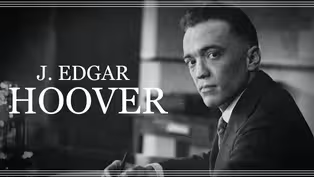
Clip: S30 | 1m 25s | The law school grad was asked to run the “Radical Division” at the Justice Department. (1m 25s)
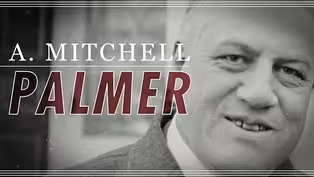
Clip: S30 | 1m 26s | In 1919, A. Mitchell Palmer created the “Radical Division” within the Justice Department. (1m 26s)
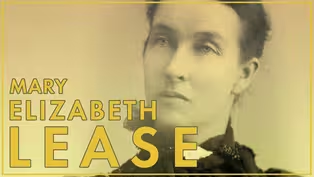
Mary Elizabeth Lease: The Advocate
Clip: S30 | 1m 32s | Women couldn’t run for elected office in Kansas, but Mary Elizabeth Lease was a force. (1m 32s)
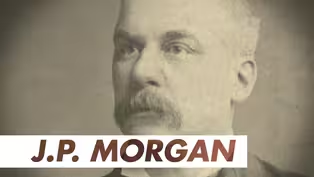
Clip: S30 | 1m 9s | When one of the richest men in America feared a collapse of the U.S. dollar, he had a plan (1m 9s)
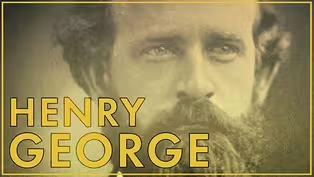
Henry George: From Poverty to Politics
Clip: S30 | 1m 35s | Henry George’s message about the haves and the have nots helped ignite a movement. (1m 35s)
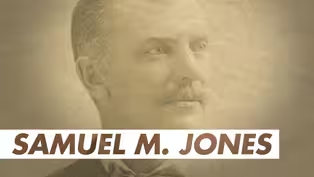
Clip: S30 | 1m 8s | The Gilded Age entrepreneur offered a workplace that was guided by the golden rule. (1m 8s)

Video has Closed Captions
Clip: S30 | 10m 6s | Watch Chapter 1 of The Gilded Age. (10m 6s)
Providing Support for PBS.org
Learn Moreabout PBS online sponsorship










Support for PBS provided by:
Corporate sponsorship for American Experience is provided by Liberty Mutual Insurance and Carlisle Companies. Major funding by the Alfred P. Sloan Foundation.