
Marlon James explores homophobia in Jamaica in new novel
Clip: 9/23/2026 | 7m 20sVideo has Closed Captions
Marlon James explores how homophobia shaped life in Jamaica in ‘The Disappearers’
Marlon James’ new novel, "The Disappearers," was shortlisted for the Booker Prize. It tells the story of a group of gay men trying to make their way, and stay alive, in the homophobic culture of Jamaica in the 1980s and 90s. It’s raw, violent and sexually explicit, while also leavened with wit and humor. Jeffrey Brown spoke with James for our arts and culture series, CANVAS.
Problems playing video? | Closed Captioning Feedback
Problems playing video? | Closed Captioning Feedback
Major corporate funding for the PBS News Hour is provided by BDO, BNSF, Consumer Cellular, American Cruise Lines, and Raymond James. Funding for the PBS NewsHour Weekend is provided by...
Marlon James explores homophobia in Jamaica in new novel
Clip: 9/23/2026 | 7m 20sVideo has Closed Captions
Marlon James’ new novel, "The Disappearers," was shortlisted for the Booker Prize. It tells the story of a group of gay men trying to make their way, and stay alive, in the homophobic culture of Jamaica in the 1980s and 90s. It’s raw, violent and sexually explicit, while also leavened with wit and humor. Jeffrey Brown spoke with James for our arts and culture series, CANVAS.
Problems playing video? | Closed Captioning Feedback
Where to Watch PBS News Hour
PBS News Hour is available to stream on pbs.org and the PBS app.
Providing Support for PBS.org
Learn Moreabout PBS online sponsorshipGEOFF BENNETT: Marlon James' new novel follows a group of gay men trying to build lives and survive amid the deep homophobia of Jamaica in the 1980s and '90s.
The New York Times has called the novel the novel of the decade and possibly of the century thus far.
Our senior arts correspondent, Jeffrey Brown, spoke with James in his first television interview about the book, which was just short-listed for the Booker Prize yesterday.
It's part of our arts and culture series, Canvas.
MARLON JAMES, Author, "The Disappearers": I write to fill in the blanks, even if the blanks are in my own life.
JEFFREY BROWN: On a recent morning in his Brooklyn neighborhood, Marlon James recalled scenes from his life and those of other gay men in the Jamaica of his youth, living in fear, hiding their truest selves, experiences he used to write his new novel, "The Disappearers."
MARLON JAMES: A disappearer is somebody who figures out how to vanish in a very public space, people we stop talking about, people we no longer see or notice.
One of the reasons why I think I could write this novel is that I'm also a disappearer.
JEFFREY BROWN: You are?
You feel that?
MARLON JAMES: Yes, I have done it, and I know -- and I still know how to do it.
JEFFREY BROWN: James has written of Jamaica before, including his 2014 Booker Prize-winning novel "A Brief History of Seven Killings" centered on an assassination attempt against reggae icon Bob Marley.
He's also written two in a projected trilogy of fantasy books, as he told me, putting people who look like him into a genre he loves.
The new novel follows a group of closeted men coming together in Kingston, Jamaica, in 1988, a time when popular songs could and did extol violence against gays and lesbians, and the threat of ostracization, or worse, was everywhere.
The characters come together to put on a play.
MARLON JAMES: Yes.
JEFFREY BROWN: But what you're showing us is that they are in some ways performing all the time.
MARLON JAMES: Yes.
They're drawn to act in a play because performing, acting, code switching is something that I think, certainly for me, if you're gay, if you're queer in a homophobic country, you learn how to act.
And you perform enough to be normal.
You don't reform enough to be exceptional.
You perform enough, again, to vanish.
JEFFREY BROWN: What did you want us to see in these men you were writing?
MARLON JAMES: That performance is survival.
They're really ultimately just trying to survive.
They survive by adapting.
And they realize who they are at the core is somebody that is rejected, is somebody that is attacked.
JEFFREY BROWN: James' characters refer to books by prominent queer authors, favorites of his.
And his own research included both readings and interviews.
The mob attack at the heart of the story is brutally violent, in one case deadly.
It's based on a much-rumored event from those years.
MARLON JAMES: This is one of the foundational fears of my young years.
This is what I think, oh, my God, this is what happens to gay people.
And I couldn't prove it.
And then it became this sort of the turning point event, the life-changing event in the novel.
And when I write about Jamaica, I tend to find an event that speaks to the fallout.
JEFFREY BROWN: You give us the inner life and the narration of the gay men, but you also let the attackers narrate what they're doing.
That was an interesting choice you made to do that.
MARLON JAMES: I -- yes.
And it was a hard choice.
I'm not really much into giving villains agency.
But, at the same time, I really wanted to interrogate what we call a mob.
And one of the reasons why I went into their minds is, I always think at any stage you have a choice.
JEFFREY BROWN: You make it vivid.
You make it powerful, extreme.
It's hard to read.
MARLON JAMES: It was hard to write.
But I am a big believer that cruelty should be examined.
I'm a big believer that atrocities should be examined.
I think we need to, one, see it and we need to interrogate why it happened.
JEFFREY BROWN: This time, James has said it's personal.
He didn't experience the violence directly, but the novel reflects the traumas, fears, and joys of his own life.
MARLON JAMES: It's personal applies in a lot of ways.
Here's a very direct one is me taking things that actually happened in my life and throwing it to a character to see how they would respond to it.
JEFFREY BROWN: It's not you, but it's based on events.
MARLON JAMES: Right.
Right, personal in the sense that I have friends and peers that age who went through coming to terms with being gay, trying on the life, and so on.
I didn't.
I ran to the church, because the church was going to make me straight.
JEFFREY BROWN: You ran to the church in the sense of, save me?
MARLON JAMES: Right, save me, change me, pray away the gay.
I even had that -- I even sent for this pamphlet shipped from Canada, and the headline is: "Are You Gay?
No Way," some of that which ended up being in the book.
In a lot of ways, that mirrors me, because I had to go through the church and realize that maybe the problem was the church, and that me.
JEFFREY BROWN: You called yourself a disappearer in a way.
So did writing become a way to appear?
MARLON JAMES: Yes.
JEFFREY BROWN: Yes?
MARLON JAMES: I started writing really just to reclaim myself.
I didn't -- I started writing just to have something that was mine.
JEFFREY BROWN: Where you were not performing and... MARLON JAMES: Where I was not performing, where I could confront fears.
JEFFREY BROWN: So was this book hard to write, painful to write, or exhilarating?
MARLON JAMES: It was hard, it was painful, but it was also cathartic, and it was also a lot of fun, because these characters are funny.
JEFFREY BROWN: Yes, humor is everywhere... MARLON JAMES: Right.
JEFFREY BROWN: ... amid all the violence, the pain, the agony.
MARLON JAMES: Yes.
And also being a teenager is a little ridiculous... (LAUGHTER) MARLON JAMES: ... especially in the '80s.
They're going through stuff, but they're watching "Family Ties."
Max, you hear that?
JEFFREY BROWN: Today, James is 55, a celebrated writer who lives with his partner, Nicholas Boggs, himself author of a noted biography of James Baldwin.
The two travel to Jamaica regularly.
WOMAN: How do you think you would have lived if you had -- if you had had to stay here?
Would you have come out or would you have... MARLON JAMES: I ask myself that question all the time.
JEFFREY BROWN: Including for a new documentary about gay life in the country today.
Things have improved, James says, with a more open scene, but some told him they still face regular threats of violence.
Overall, he says: MARLON JAMES: I'm optimistic because the young people are optimistic.
I'm optimistic because when I say, maybe things will be a little better in 20 years, they look at me and go, 10.
I worry because I see the contradictions going on around me.
But I -- their -- the young people I speak to, their confidence is very contagious.
JEFFREY BROWN: All right, "The Disappearers."
Marlon James, thank you very much.
MARLON JAMES: Thanks for having me.
Former Kansas GOP governor backing Democrat for Senate
Video has Closed Captions
Former Kansas GOP governor explains why he's backing Democrat Adam Hamilton for Senate (7m 16s)
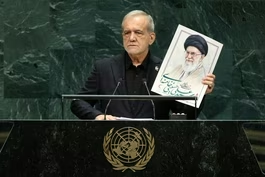
Iran's president responds to Trump's 'annihilation' threat
Video has Closed Captions
At UN General Assembly, Iran's president responds to Trump's 'annihilation' threat (4m 56s)

Moldova's PM on confronting Russia and backing Ukraine
Video has Closed Captions
Moldova's PM on confronting Russian threats and backing Ukraine (7m 7s)
New poll reveals how Trump's approval might affect midterms
Video has Closed Captions
New poll reveals how Trump's low approval might affect midterms (4m 41s)
News Wrap: FBI investigating claim website was breached
Video has Closed Captions
News Wrap: FBI investigating hacking group's claim it breached jobs website (5m 47s)
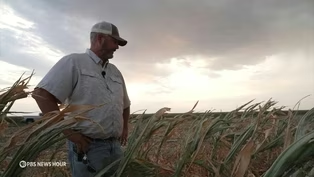
What's making it harder for American family farms to survive
Video has Closed Captions
What's making it harder for American family farms to survive (10m 11s)

Xi arrives for state visit amid U.S.-China trade tensions
Video has Closed Captions
Xi arrives for state visit amid U.S.-China trade tensions and AI concerns (4m 51s)
Providing Support for PBS.org
Learn Moreabout PBS online sponsorship New Episode
- News and Public Affairs

FRONTLINE is investigative journalism that questions, explains and changes our world.
 New Episode
- News and Public Affairs

Today's top journalists discuss Washington's current political events and public affairs.
 New Episode
 New Episode
 New Episode
 New Episode
 New Episode
 New Episode
 New Episode
Support for PBS provided by:
Major corporate funding for the PBS News Hour is provided by BDO, BNSF, Consumer Cellular, American Cruise Lines, and Raymond James. Funding for the PBS NewsHour Weekend is provided by...