
September 17, 2026
9/17/2026 | 55m 21sVideo has Closed Captions
John Manley; Anthony Gardner; Jay Inslee; Jacob Weisberg
Former Canadian Deputy PM John Manley discusses Canada's budding relationship with the EU. Former US Ambassador to the EU Anthony Gardner further analyzes Canada's growing connection to the EU. Former Washington Governor Jay Inslee weighs in on the climate crisis. Journalist Jacob Weisberg tells the stories of leaders who capitulated to Pres. Trump in his book "Profiles in Cowardice."
Problems playing video? | Closed Captioning Feedback
Problems playing video? | Closed Captioning Feedback
September 17, 2026
9/17/2026 | 55m 21sVideo has Closed Captions
Former Canadian Deputy PM John Manley discusses Canada's budding relationship with the EU. Former US Ambassador to the EU Anthony Gardner further analyzes Canada's growing connection to the EU. Former Washington Governor Jay Inslee weighs in on the climate crisis. Journalist Jacob Weisberg tells the stories of leaders who capitulated to Pres. Trump in his book "Profiles in Cowardice."
Problems playing video? | Closed Captioning Feedback
Where to Watch Amanpour and Company
Amanpour and Company is available to stream on pbs.org and the PBS app.
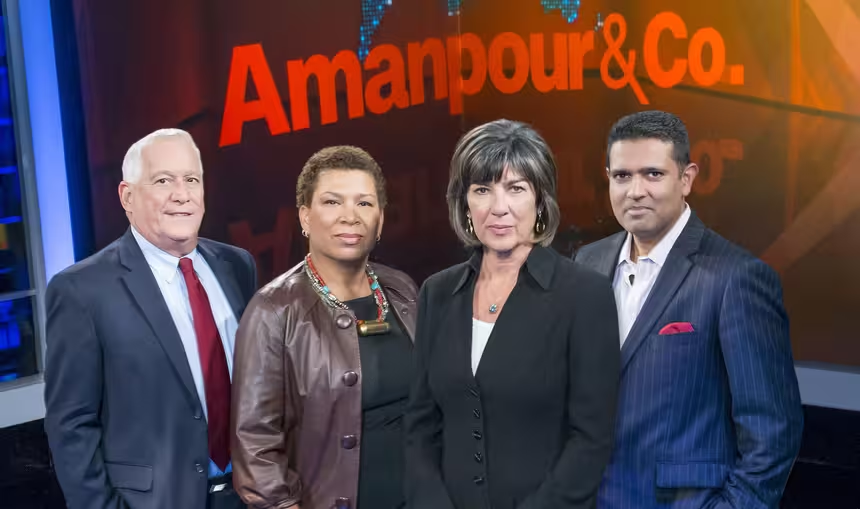
Watch Amanpour and Company on PBS
PBS and WNET, in collaboration with CNN, launched Amanpour and Company in September 2018. The series features wide-ranging, in-depth conversations with global thought leaders and cultural influencers on issues impacting the world each day, from politics, business, technology and arts, to science and sports.Providing Support for PBS.org
Learn Moreabout PBS online sponsorship[ Music ] >> Hello everyone and welcome to Amanpour and Company.
Here's what's coming up.
>> Canada and Europe are each strong.
>> Europe and Canada are stronger together.
>> A new special relationship?
Canadian Prime Minister Mark Carney pulls closer to the EU after months of Trump tariffs, threats, and taunts.
What it says about the new world order?
Then, no more limits.
Washington's environmental policy gives power plants a free pass on climate pollution.
I speak to Washington State's former governor, Jay Inslee, who spent years warning about this moment.
Plus-- - These are people I expected more from.
- Profiles in cowardice.
Writer Jacob Weisberg talks to Michel Martin about his book on the powerful people and institutions who first resisted Trump and then caved.
♪♪ Candace King Weir; Sylvia A. and Simon B. Poita Programming Endowment to Fight Antisemitism; The Peter G. Peterson and Joan Gantz Cooney Fund; Charles Rosenblum; Monique Schoen-Warshaw; and Patricia Ewan, committed to bridging cultural differences in our communities.
Barbara Hope Zuckerberg.
And by contributions to your PBS station from viewers like you.
Thank you.
>> Welcome to the program, everyone.
I'm Christiane Amanpour in London.
Is this the beginning of a new world order?
Canada and the European Union announced the start of a new relationship, setting Ottawa on the path to become the EU's first associate member.
The unprecedented transatlantic move comes after the United States has targeted its neighbor and old ally, imposing big tariffs and threatening to make it a 51st state.
Here's Prime Minister Mark Carney addressing EU lawmakers in Strasbourg today.
I'm not proposing a third bloc in order to become a great power rival only with better manners.
We do not seek power to dominate others.
On the contrary, we are pursuing resilience so no one, no one can control our open markets, impair our sovereignty, threaten our territorial integrity, or undermine our freedoms, our democracies, our rule of law.
>> President Trump calls the proposal laughable and is already threatening "serious tariffs on the bloc."
But what does this announcement actually mean?
Today, there are more questions than answers about this unexpected term.
So let's get into all the drama and melodrama with John Manley, Canada's former Deputy Prime Minister.
John Manley, welcome back to the program.
The zinger landed about, you know, a superpower with better manners, but then there was real substance as well as to why Prime Minister Carney thinks that this is something that needs to happen now, this workaround.
What exactly do you think he is proposing?
He's clearly proposing closer relationships on a variety of levels.
Understand that there are already close ties between Canada and Europe.
We have a comprehensive trade agreement with Europe, the CETA, which was signed a number of years ago.
Of course, many European countries are part of NATO, but we're also part of SAFE, S-A-F-E, which is their European Defence Program.
Canada, I think, is the only non-European country to be part of that, but I think there are more ties that can be built institutionally, but also with universities, with educational facilities, with efforts in the world arena, where Canada and Europe are quite closely aligned, both in terms of values as well as policies.
An obvious question is why?
And I suppose we have to accept that it goes to Carney's speech in Davos earlier this year, when he described the current state of affairs, how there was a transatlantic rupture, not a transition, how middle powers should basically band together to, you know, in the big picture, protect and defend democracy and values.
Is this all about Trump and his reaction and threats and tariffs to Canada and his view of the transatlantic relationship or is there more to it?
I think clearly this was all stimulated by the president's actions and his attitude.
As you've been following, he's continuing to make comments about Canada which truthfully we're not accustomed to hearing.
We've had differences of course with the United States both in terms of policy but also on trade issues.
Those go back and forth but they're normally dealt with by professionals and in a very quiet and calm fashion.
President Trump saying we're nasty people, you know, one of the things Canadians actually think of themselves is that we're kind of nice.
This is quite shocking to the Canadian mentality.
And so I think the beginning of a closer relationships with Europe and with Asian partners is natural in this.
It is an inflection point for Canada, and Canadians feel it, not because we can, you know, move away from the United States.
It's a very large, very proximate economy, but so that we begin to build those networks elsewhere that really shield us against some of the volatility that we've found coming from Washington over the past years.
And Mark Carney went on to talk about and call for strategic autonomy in the areas of defense and energy, critical minerals, AI, etc., etc.
You've heard what President Trump's reaction has been, basically saying, "If this is a hostile act, I will act, and I will impose sanctions, or rather tariffs, more tariffs, for instance, on the EU."
So where do you think this is going?
Is it another sort of ratcheting up of this whole tariff war?
Do you think the EU and Canada can convince the United States that this is not a hostile act?
Well, first of all, I think we've reached the point now where we tune him out when he makes these threats.
There have been so many, so varied, so many are completely, I mean, in that same little speech that he gave at the bottom of the steps from his airplane, he also said he could potentially stop trading altogether with Europe.
That's 450 million people on the other side.
That's a pretty large trading block to just say we're we're gonna we're gonna lock them out.
We honestly don't take that too seriously anymore and I think Prime Minister Carney has been very careful to express this as not an anti-US move but as one which as he says builds resilience.
We need other partners.
If the president thinks that he can exert extreme leverage on Canada because of the volume of our trade that crosses that Canada-US border, then we better find other alternatives because some of what he asked for in the trade negotiations that broke down would not be acceptable to Canadians.
And I remember Mark Carney's reason for not being able to go ahead with this trade deal was he also said that it infringed very, very, very strongly on Canada's sovereignty.
Now he was saying in his speech today, and let me read a little bit of it, he's talking about, this is a metaphor he's used, "In today's ferocious storm," he said, "a single tree will come down, a forest will not."
What is the storm he's talking about?
Is it just the United States and the president, or is it also China?
And who or what is the forest?
Well, first of all, I think it is.
It's... he made... paints in the clip that you showed to talk about we're not trying to create another great power here.
There are obviously two great powers, certainly in economic terms and largely in military terms on the planet today.
This isn't an attempt to duplicate one of those, but I think it is important that he highlighted the forest as being built around principles, rule of law, democracy, and the basic liberal economic order that we've all enjoyed really for the last 75 years that has been shaken by this return of 1930s-style trade restrictions.
So I think when you add it all up and you look at Europe, you look at Canada as a bridge from Europe to Asia, the Asian economies, particularly Japan, Korea, Australia, New Zealand, and some of the ASEAN countries, you can see that we can, you know, that's a pretty large trading block in itself.
And if we can continue to adhere to the principles that established the really incredible production of wealth over the 75 years preceding Donald Trump, then we've got something to offer when inevitably this experiment in bizarre economics in the United States comes to an end and more routine procedures can begin again.
In the meantime, of course, this whole idea of associate membership is completely novel.
Nobody quite knows what it means.
Everybody is quite blindsided by the introduction of this and the offer of this from the EU president.
But also Canada, its biggest trade partner, is the United States.
Can Canada actually afford to diversify away from the United States in a meaningful way?
Well, Mr.
Trump's tariffs are making it necessary for us to do that.
50% on some important commodities, 100% when you add all of the tariffs together, which is essentially a barrier.
So, we have no choice.
Clearly, it's hard to do.
I'd say it's analogous to saying, you know, can the moon decide it's going to stop orbiting Earth and orbit Mars?
No, that's just not going to happen.
And the size and proximity of that U.S.
market, as I said before, are going to continue to be very big drivers of economic activity in Canada.
And also, this too shall end.
I mean, these tariffs are costing Americans.
I mean, the notion that they're paid for by other countries, people have begun to realize that's just not true.
They're being paid by Americans, and they're driving up prices and costs for Americans in their daily lives.
This will not continue indefinitely.
But Canada, you know, and it is sort of true that the American negotiators said, well, Canada walked away from the best deal we offered anybody.
It's important that you put that in context.
It may have been if you only look at the offered tariff numbers.
But remember two things.
One, we already have a deal with the United States that was signed with Trump in his first administration, which he praised, that calls for zero tariffs.
And number two, it wasn't so much the tariff numbers that caused that negotiation to break down, but the demands that all packaging can be in English only.
In Canada, that doesn't work with us.
That they get a preemptive right to critical minerals, that they get a preemptive right to our energy resources.
These were, and get to say who we can sign trade agreements with, these are impingements on our sovereignty that no Canadian leader could ever live with.
And it's just so interesting to see the way your current Prime Minister is trying to take Canada's best interests and make them happen.
So thank you for joining us.
Now let's talk about the EU aspect of this and we're going to turn now to Anthony Gardner who is the former US ambassador to the European nation or rather Union and you are joining us from Italy.
So welcome to the program.
You, Mr.
Gardner, have just listened to Mr.
Manley.
You've obviously been looking very closely at what's been going on in Strasbourg.
And now Mark Carney is coming to the UK to talk to another middle power, Britain.
What do you make of this?
Is this a goer?
Is there a structure that can make this actually work?
Well, first of all, good to see you again, Christiane.
There may well be more structure sooner rather than later.
I want to say, first of all, I've gotten to know Mark Carney.
I've worked with him and I think he's a smart, rational, thoughtful person.
And Canada is very lucky to have him as Prime Minister.
And if only we could clone him, frankly, the world would be a better place.
Look, what has happened in Strasbourg is significant.
I would say Christiane, it's politically significant.
We pointed out no one knows what this associate membership actually means, but it's significant because he addressed the European Parliament.
He was present when European Commission President Van der Linde gave her speech.
And no doubt there will be more meat on the bones soon.
The message is clearly we have options.
Canada and the EU are saying we have options to the world.
We will diversify.
Oh, and by the way, world investors take note, we are a safe haven of stability and predictability and rule of law, and all of those things should matter to you in a world which some countries are becoming more corrupt and volatile and unpredictable.
So I think yes, the UK is part of what Mark Carney said at Davos in January.
The middle powers have their power too.
Really interesting.
And it's just so interesting to almost be at the beginning of maybe a new order that's being birthed, or maybe not.
We'll see where it goes.
But do you think that there's a way for Mark Carney to do this that does not, you know, raise Trump's ire?
And the ire is always, you know, by economic punishment.
So it's important not to do stuff that brings more tariffs, more pain.
Can that happen?
Already you heard, you know, what President Trump said.
If he believes it's hostile, he'll take economic action towards the EU.
What Mark Carney said in his speech, what this is, the associate membership is not aimed against anybody.
I think the EU Commission President said the same thing.
It's not aimed against anybody.
It's simply because we need to protect our ability to, well, to protect ourselves and to have a certain degree of autonomy in a world which is increasingly hostile to us.
So this is a reaction to the reality of the new world.
So what Trump decides to do, of course, is his own choice.
But I think it's a smart thing for both powers, Canada and the EU, to act in this way.
I think they're going to look at ways of working more closely together.
You mentioned some of the sectors.
It's not going to be a bigger free trade agreement.
It already exists, as your prior speaker said.
It's not going to be some form of membership like the European Economic Area, but there are a lot of areas where Canada and the EU can actually work more closely together.
I should just mention one other thing, Christiane.
You know, the EU does have tools to defend itself.
It could have used those tools last year during the trade negotiations with the EU.
One of them is the so-called anti-coercion instrument which was tailor-made for precisely this set of circumstances when a foreign power issues threats.
It's a very broad tool that you could basically do anything.
It chose not to use it, in fact not even to use the first phase of that process, so it was not credible as a threat and lay on the table.
Now let's see whether the EU actually chooses to use it.
What's the point of having trade defence mechanisms, trade enforcement tools, if they're never used?
So let me just ask you, is that the bazooka that was floated last time that they decided not to use, i.e.
counter tariffs and that kind of stuff?
Absolutely.
It's more like a water pistol than a big bazooka.
I mean, that's exactly the issue.
It was not credible for the White House.
They were absolutely right in looking through this and saying, look, the EU is never going to use this.
It didn't, for reasons we all know during the trade negotiations.
Several member states, export-oriented industries called up the European Commission and said, "Sign the deal.
Basically, sign any deal.
We want peace, even the short-term peace at long-term cost."
But this has consequences over the longer term.
The Chinese are looking.
They're taking notice that threats yield results.
>> Mm.
And obviously, what happened that you're describing was, I guess, a year or so ago, and things have changed a lot.
And now they're changing.
It was Ursula von der Leyen, not Mark Carney, who raised the idea of associate membership.
And, of course, it's causing some ructions amongst other E.U.
states, most of all, you know, nations that don't want to think about separatist, you know, movements and this and that, and that would threaten their own sovereignty or set some kind of a precedent.
So how is this going to be diplomatically finessed?
And what do you think the result of this new attempt is going to be?
Well, it's a great question.
So indeed, you're right.
Some member states have already sounded a bit skeptical about this.
It sounds like she may have lent, you know, gone a little bit far before clearing it with everybody.
The idea is, well, we can't offer things out of fear of Trump's reaction.
We've seen what's happened.
We can't offer things that other privileged partners like Australia, New Zealand, Japan, Korea may want to have.
We don't want to annoy them.
And by the way, we member states, we have to unanimously approve something called associate membership, and that's not going to be easy.
So you're right, this is not going to happen fast.
But what I said before, this is politically significant.
They're probably going to enter into a number of sectoral agreements where they can work together.
It could be, well, they mentioned, you know, quantum and AI and energy, and you can go through the list.
So I think it's politically significant, and eventually we'll see more meat on the bones.
And finally, I just want to talk about more about this expanding members business.
Mark Carney says the alliance should eventually be open to others so that they can join.
Here's what he said.
A Canada-EU alliance would create a beacon for other democracies.
An alliance not defined by what we oppose, but about what we are for.
Freedom, solidarity, prosperity, sustainability.
An alliance strong enough so that no one can dictate our choices.
An alliance open enough that others can join.
An alliance principled enough that our strength reinforces international law rather than seeks to replace it.
I mean, Anthony Gardner, this is very grand.
This is not just a small detour around the world order.
This is almost creating a new one, some would say a workaround, because of the United States right now.
But nonetheless, that's a call to arms to protect the current rules of engagement and international rules of the road.
He's calling for that, yes.
I would say a call to arms, but he's calling for continuing respect of what made us prosperous in the last 80 years after the war.
And I'll remind all your viewers that 85 percent of the world continues more or less to follow world trading rules obviously with it with exceptions the 15 percent is the United States decided not to but it's one example of how a lot of countries still see value in rules and in laws and in multilateralism so his call I think is to a lot of countries and say you know what before we throw all of these principles away why don't we band together and protect actually things that have made us as I mentioned prosperous and secure.
Well it's a really interesting thing to be watching and Anthony Gardner we thank you very much for coming and explaining it.
The catastrophic flooding that ripped through Nepal last month was caused by a slew of factors, experts say, many of which were worsened by a warming planet.
The first scientific study of the incident found there were unusually warm conditions that preceded the collapse of a major glacier that triggered the landslide, with over a thousand people killed and many thousands more who are still missing.
It's the latest example of the deadly effects of the climate crisis as we exit a summer that was the hottest on record in many parts of the world.
Meanwhile, the United States, one of the world's worst polluters, is eliminating any limits on regulating greenhouse gas emissions from power plants.
Now, as governor of Washington state, Jay Inslee prioritized the climate crisis, and he calls this latest move a despicable abdication of the EPA's duty to the American people.
And he's joining me now from Seattle.
Welcome to the program, Governor Inslee.
Tell us what precisely is despicable, what precisely are they doing, and why is it so despicable?
Well, I think in public affairs debate is healthy to some degree.
There's different views, and perhaps we should excuse public officials who don't do what we want them to do.
But there is no excuse for a public official, including the President of the United States, to totally abdicate his or her responsibility to walk away, to go AWOL from the protection and the protection obligation.
This is the Environmental Protection Agency.
It is by law charged with the responsibility of protecting children's lungs from pollution that comes from coal-fired plants that cause direct epidemics of asthma.
It's charged with the legal obligation to protect Americans in the world from the pollution that is making climate change, which is now, you know, burning down half the West and flooding the rest of America.
And this president has walked away and gone AWOL and going AWOL to leave your your post of responsibility is the most grievous insult of anybody's public responsibility and that's what he's done.
You know Governor, you say AWOL, but actually from what we hear from the president and from the EPA administrator is that this is deliberate.
This is a policy that they think is best for the United States.
Before I get to what they actually say, I just want to ask you about the consequences because the EPA itself says that this new rule, this rollback, will add a hundred and twenty three million metric tons of carbon emissions.
What does that mean for instance for the people of your state and elsewhere in the United States?
It means more young children going into emergency rooms on a daily basis because they're having severe asthma attacks.
And if you've ever been around a child who can't breathe because of an asthma attack, you would think the total elimination of the ability of the Environmental Protection Agency to protect these children from the toxic material coming out of coal-fired plants was an immoral act.
It's causing premature death of people from a host of cardiovascular diseases by the tens of thousands in the United States of premature deaths.
Now that's the first order.
It's causing economic loss because of our health care costs are going up in the billions of dollars associated with additional toxicity that we breathe every day.
Now, those are the first order losses.
The second order is that it precipitates climate change, which is burning down 500 houses in Spokane, Washington, a beautiful town in eastern Washington.
I went and met two brothers, both homes have burned down because of these fires that are becoming so endemic across the West.
And the third order of magnitude, it is increasing the cost of Americans that we have to pay for electricity.
Look how absurd.
This guy in the White House has ordered a coal-fired plant in Washington and Centralia to stay open, even though its electricity is so expensive, no one will buy it.
So he is in a corrupt bargain to help his cronies, who have helped him politically, stay in business when they have the most expensive electricity, which is coal-fired-based electricity.
So there's first, second, and third order, and the fourth order is corruption, and we ought to be outraged.
- What they say, the EPA Administrator Lee Zeldin basically has accused the Obama and Biden administrations of "waging a war on coal that forced many plants to close prematurely."
This is what he said earlier this week.
- There used to be, at the EPA, a choice where they would say that in order to protect the environment, you had to suffocate out of existence entire sectors of our economy.
No more.
- So that's one view.
And then Michael, sorry, Michelle Bloodworth, President of America's Power Coal Industry Trade Group says, "The Biden-era rule would have led to widespread retirements "of coal power plants desperately needed to keep pace with America's exploding demand for electricity."
What's your response to that?
Because it really does seem like comments from another era.
It just seemed that the world was pretty much in a consensus that coal, of all the emissions, was the worst.
- Well, listen, this is a replay of the tobacco industry that tried to convince us that continuing to be addicted to tobacco was a healthy thing for America.
We finally overcame the corrupt bargain between the tobacco industry and Congress, and now are trying to save people's health.
And it is the same thing with coal, with one exception.
And that is the fact of the matter is, and this is the fundamental truth that these guys refuse to recognize, is that coal-based power is the most expensive power in America today.
Now, I say that because the facts back it up.
Ninety-two percent of all the new generating capacity in the United States that was brought online last year was clean, a renewable source of energy, because it is cheaper.
What Trump is trying to do is to foist down the throats of helpless citizens the more expensive source of energy, which is coal, and there's a reason he's doing it.
Look, in Mar-a-Lago, before the election, he went to the fossil fuel industry and basically said if you give my campaign a billion dollars, I'll protect your ancient industries that cannot compete now, because it's too darn expensive.
That's what we're facing in my state right now, where we actually shuttered a coal-fired plant, and he's issued an illegal order to keep it open.
But guess what?
Nobody will buy the electricity from this plant, because it's so expensive and we can get energy much cheaper.
So the fact of the matter is, this is a reversal from 50 years of the situation where coal was cheap and is now the most expensive.
But he's trying to keep alive the buggy whip industry of an industry that can't compete either on a cost basis or certainly on a health care basis system.
And I repeat, there's a legal obligation that they have ignored here to protect people's lungs as well.
And just to throw out the usual suspects, the Chinese, the Indian government and states, which do still produce a lot of and use a lot of coal and produce a lot of pollution.
If the U.S.
says, "Well, why should we be trying to catch up or be, you know, you know, sort of on the back foot while these other countries are allowed to, you know, use coal for their populations, for jobs, for production, etc.
Well, the first reason is we're the ones that are breathing smoke from the stacks that are just a few miles from our homes.
We're breathing domestic pollution, domestic, particularly small particulate matter that gets deep into a child's lungs and old folks that cause cardiovascular diseases.
So the first order of business is to stop this industry from poisoning our own people and our neighborhood's plants, if you will, even though that they're miles away.
That's the first order of business.
The second is that, look, China is now producing an enormous number of solar cells, and the Trump administration is trying to kill our domestic industry to actually produce solar power here.
You know, he's actually—we have wind power that's available and cheaper than coal.
We have solar power, which is abundant and cheaper than coal.
We have batteries that can now be wired with wind and solar to level out the curve of energy, cheaper than coal.
And he has done everything humanly possible to stop the development of these cheaper sources of energy.
Now that hasn't got anything to do with China.
Look, if we want to have a domestic healthy energy industry, we should not let him strangle the domestic sources of energy which we can produce.
And I never thought I'd see the day when an American president denies Americans the ability to get cheaper, healthier energy.
And that's what he's doing right now.
And China's not an excuse for trying to deny Americans access to cheaper energy.
- And there were extraordinary reports and investigations and reporting saying that actually the administration is paying companies, even foreign companies, not to invest in wind and solar in the United States, as you just said, paying them off basically to cancel their contracts.
But I want to ask you this.
One of the more astounding statements from the EPA during this announcement this week, this is from their press statement.
"Models continue to show that greenhouse gas emissions from power plants have no material impact on global climate change.
In fact, if all carbon dioxides were eliminated tomorrow, there would be no meaningful climate impact."
What's your reaction to that?
Well, when I hear the president and his minions and his subservient cult in Congress say things like that, it makes me worry more about natural stupidity than artificial intelligence.
Those are the most absurd comments that you can imagine.
Now, you've got to put this in context.
This is a guy who says he's going to shut down the Kennedy Center unless he puts his name on it.
So I don't know how to explain these things except to say that truth is not a restraint in any matter in this regard.
And you know, there's lies and there's lies that can kill you.
And I guess lies, maybe they're acceptable, I suppose, but not in this case.
And the reason is his lies are costing lives of people I know.
Look, I've been to the Altadena fire victims down in Los Angeles.
I saw the Paradise fire victims.
You saw the victims in Lahaina, 80 people.
I talked to one of my friends.
If he turned left, he would have been incinerated in the line of fire.
Fortunately, he turned right and he got out.
And three weeks ago, I went to Spokane, Washington, and met the fire victims where 500 homes burned down, essentially associated with fires that are now twice as likely, at least twice as likely, and are gaining ground, unfortunately, in the West every single day.
And every scientist on the planet who has any credibility, doesn't work for the fossil fuel industry, recognizes that CO2 and methane are a direct causative effect that are causing hotter temperatures, more aridity.
It's drying out the forest and the grassland.
It's causing these fires.
And importantly, it's causing more floods as well.
And Nepal is the most obvious measure where whole glaciers are collapsing.
In the Alps, you can't climb a lot of the mountains right now because the mountains are falling apart because they're melting.
I'm looking at Mount Rainier right out my window right now.
Forty percent of the ice has disappeared on Mount Rainier because of climate change.
And it is clear, beyond a shadow of a doubt, that this is associated with essentially two greenhouse gases that we put out by the millions of tons, carbon dioxide and methane.
And there's, there's lies, and then there's fatal lies.
And their category believes in the category of fatal lies.
And when you see people standing in the ashes of their homes... You're sounding the alarm.
You bet.
Yeah, I know.
It's a very dramatic picture that you're painting.
And we're glad to have you on, frankly.
And we know that as governor of the state of Washington, you've done so much to combat this and to protect your own people.
Now, thank you, Governor Inslee, for being with us.
Now, what do Jeff Bezos, George W. Bush, and Chief Justice John Roberts have in common?
Well, they're all subjects of a new book by the journalist Jacob Weisberg, Profiles in Cowardice.
It delivers a stark twist on JFK's famous title, Profiles in Courage.
And he is now speaking to Michelle Martin about what he sees as a broad collective failure to defend democracy.
Thanks Christiane.
Jacob Weisberg, thank you so much for talking with us.
Thank you, Michelle.
I'm glad to be here.
So your latest book, Profiles in Cowardice, deliberately turns John F. Kennedy's profiles in courage on its head.
And just to remind people who may not remember this book, Kennedy profiled eight people that he was inspired by who stood up against great odds or some risk to themselves at sort of perilous moments.
And so I was just wondering when you got the idea for this?
Well I got the idea right early in Trump's second term because I was so aware of the difference from his first term.
In the first term I felt the guard rails protecting democracy mostly held.
They were a little shaky but they held.
And the second term, it felt very much like they weren't holding and aren't holding, because institutions and civil society was caving into him against so many of its basic principles.
So I wanted to understand why it was different and to actually look at the pressures on these institutions and on the people who lead them to try to understand what had happened.
So you profile eight powerful figures in different fields, politics, business, law, media, academia, and you say that if public courage is a principal choice made under conditions of pressure, cowardice is the evasion of that choice.
Where courage is a presence, cowardice is an absence, being nowhere to be found at the critical moment.
I was trying to figure out what was the through line for all these—for these eight people—Jeff Bezos, owner of The Washington Post; Mitch McConnell, you know, former Senate leader, currently in the Senate; Chief Justice John Roberts on the Supreme Court; the president of Dartmouth; former president George W. Bush; Megyn Kelly.
And I was trying to figure out what is the through line here?
Is the through line that in the first Trump term they actually did stand up against pressure, illegal acts, violations of the public trust, and in the second term something else?
Yes, to different degrees and in different ways.
But yes, I think these are people I expected more from because at some point they did assert principle and they did in whatever way resist Donald Trump.
Bezos is sort of the perfect example.
I mean, in Trump 1, I thought he was a fantastic owner of the Washington Post.
He really, Trump tried to pressure him, bully him to get the Post to go light in its coverage, and Bezos didn't give an inch, and Bezos was punished for that.
Trump tried to take a ten billion dollar contract away from Amazon just to punish Bezos for what the Washington Post was doing.
And Bezos didn't flinch, but in Trump II, he flinched.
He started the, even before Trump was inaugurated the second time, he went down to Mar-a-Lago on bended knee, paid 40 million dollars for the Melania Trump documentary, which was a price that bears no relation to its value or for anything Amazon Prime had ever paid for rights to a documentary before.
And he'd been a terrible steward of the Washington Post and Trump, too.
So I think it creates a kind of mystery.
This is the same person.
He didn't wake up and turn evil.
What happened?
What did you come up with?
For Bezos, I think it's about space.
I think he has a childhood dream of putting people into outer space.
I think what happened in the second term is his conflict with Trump threatened to derail that.
His company, Blue Origin, was just losing out to Elon Musk's SpaceX.
It was losing out in part because Musk was in with Trump and SpaceX was getting the government contracts from the Pentagon and NASA, which is what the whole business depends upon.
And I think there's nothing more important to Bezos.
I think he sees it as his legacy.
It's what he does instead of philanthropy.
And in that context, I think he's pretty ready to sacrifice the Washington Post and a lot else.
And what about George W. Bush?
I feel that I can say with assurance, as you do in the book, that there are many people around him who are quite puzzled by his silence when, you know, President Trump has not just insulted, you know, him and his family, his father, himself, but also tried to dismantle some of the proudest achievements of his administration, things that he cared deeply about.
What's your take on that?
Yeah.
Well, this is a sin of omission, as you say.
It's that Bush can't bring himself to say Trump's name.
And for someone whose whole idea of the presidency was based on applying a kind of simple right and wrong morality, you know, call evil by its name, he just won't say it.
And this is, as you say, a president who has destroyed PEPFAR, I mean, a thing that Bush did that pretty much everyone in the world agrees was wonderful.
I mean, PEPFAR, the, you know, program that brought antiretroviral drugs to HIV-positive people around the world in Africa and elsewhere, probably saved 25 million lives.
I mean, it's an illustration of the good that good government can do.
And even when Elon Musk was effectively destroying that, Bush wouldn't speak up publicly.
I think there are various reasons for it.
I think the biggest one is that he's trying to restore his post-presidential reputation, and that involves running the library and the foundation and raising a lot of money within a Republican world in which antagonizing Trump supporters and antagonizing Trump will sort of bring this raft down on him.
You know, Trump said, I mean, there's no love lost between Bush and Trump.
Trump said when he first ran for president that Bush was responsible for September 11th.
Not that he'd handled it badly, but that the Twin Towers came down because of him.
I mean, I have to say, as someone who, you know, wasn't in any respect a Bush supporter, that's just an appalling, repulsive thing to say.
But Bush just won't, he won't get into it.
And there are people around him who have been encouraging him to do it and want him to do it.
And, you know, it's not, we don't want our ex-presidents to be political pundits.
He doesn't have to weigh in on everything in the news.
But to make a moral statement, and he could have made a moral statement at a couple of moments when I think he could have really made a difference.
- Okay, so you talk about George W. Bush's Sins of Omission.
So let's talk about Brad Karp.
You call his chapter "existentialist."
So first of all, would you just describe, for people who aren't familiar, what's the history of Paul Weiss as a law firm?
- So it's the outstanding liberal law firm that is also a hugely successful transaction firm, Wall Street firm that represents big companies doing mergers, acquisitions, private equity.
And for a long time, and this, you know, this firm goes back, you know, to the to the late 19th century, it goes back more than 150 years now.
It has always done both of those things.
And it played, it has a kind of storied role in the civil rights movement, it stood up for the rights of immigrants.
In the first term, Brad Karp, who I think was, you know, very sincere about this, provided him himself on sending 75 lawyers from Paul Weiss to the airports in New York when Trump declared the first Muslim ban, subsequently thrown out by the courts, to say, if people who have a right to enter the country are going to be denied entry, we're going to have lawyers there to help them, you know, so that the firm had this liberal identity, at the same time as it's had an identity as a top Wall Street firm.
And so Brad Karp, when Trump returns to office, it's immediately—it's almost kind of an immediate target.
And so what does he do, and what does Brad Karp do in response?
Yeah, so one of the first things Trump did after his re-election was issue an executive order targeting Paul Weiss.
His firm has more than a thousand lawyers, and this executive order said no Paul Weiss lawyer can enter a government building, and those that have security clearances were stripping those security clearances away.
Well, if you're a lawyer, you pretty much have to go into government buildings to represent your clients and do your work.
I mean, this was, Carp called it existential because what he was saying was, we can't survive as a firm if the president is declaring us essentially illegal in the way he was.
Now, that order was totally unconstitutional, and firms that challenged other orders have been completely vindicated.
They've won every ruling in federal courts.
Those rulings haven't been upheld.
But Paul Weiss, instead of filing for an injunction to say, "Mr.
President, you can't do this to us," which I think they unquestionably would have been successful with, started negotiating.
And Karp made, in just five days, he went down to Washington, he went to the White House, and he cut a kind of deal where Paul Weiss agreed to do $40 million in unspecified pro bono work for the government.
They agreed to eliminate their DEI programs, anything to do with affirmative action, and a bunch of other vague stuff that essentially, in one way or another, let Trump say they've admitted that they did terrible, terrible things.
Is it possible that some of the people you profiled here, rather than being cowards, just changed their minds?
None of them are making that case.
None of them are saying they—Jeff Bezos a little bit says he changed his mind, but even he says, you know, Trump is really different this time.
He's matured, he's more stable, he's calmer.
Even he realizes you need to come up with some kind of justification for being such a different person the second time around.
But no, I don't think they really changed their minds.
I don't think, I also don't think they woke up one day and decided, hey, it would be a really good idea to have a dictator instead of a president.
I think they have succumbed to these different kinds of pressures.
I think they've been weak, but I don't think they've made anything like a principled, intellectual, or analytical decision to support someone they used to think was terrible.
You know, it is interesting because the people who have opposed Trump have paid with their careers.
I mean, some of them have found new life and new voice in other arenas.
I'm thinking about Miles Taylor, who is a lifelong Republican, was serving in the Department of Defense, found that the president was eager to engage in conduct that he could not countenance, and has become a prominent voice sort of in opposition, has paid a price for that.
You're thinking about people like Adam Kinzinger.
You're thinking about people like Liz Cheney.
You're thinking about people who sort of had their security clearances withdrawn, people who've been sort of prosecuted.
And people look at that and they go, "It's just not worth it.
It's just not worth it."
Is that cowardice?
But think about what those people have gained.
I mean, the respect of their families, I think of history, of, you know, they can hold their heads high.
I mean, I really admire Liz Cheney exactly for that reason, that she knew what she was going to sacrifice, not just not being able to be in Congress anymore, but, you know, this kind of ostracism.
Wyoming's a pretty right-wing, Trumpy place.
And people who are her friends her whole life don't talk to her.
She's been sort of cast out.
But at the same time, I think if you take a longer view, view of history, but also maybe a future in which we have a normal Republican Party again, you know, if there's a Republican Party that eventually breaks with Trump and repudiates him, who are going to be the people who are going to be clean enough to lead that party?
Liz Cheney, I think, is top of the list.
So you say, once a few prominent actors make the seemingly rational choice of safety, everyone else can say they're merely being prudent.
That's how democracy dies, not by waving a white flag in a final battle with dictatorship, but through a thousand respectable, reasonable retreats.
Each of the eight figures I've chosen to profile embodies a different interplay of these factors and others besides.
When you finished this examination, how did you think about it?
I think there is a sad commentary here about American elites and about their sense of institutional responsibility and the narrow way in which they conceive it.
But something else I took away from the book is actually back to this idea of what is courage, what is cowardice.
I think going in, I thought of it much more as a matter of individual moral choice, and someone who is going to do the right thing or isn't going to do the right thing, and the courageous person makes the harder choice and does the right thing.
And that's absolutely still true.
I mean, you can't take the personal moral choice out of the equation.
The eight people I wrote about are people who made specific bad choices, which is what I'm interested in.
But I also think there is a social dimension to it and a context to it that drives so much of the behavior.
And if you look at what's different between Trump 1 and Trump 2, it's not just that specific people made specific bad choices.
It's that the wind was going in a different direction, and people look around at their peer groups, and they look at what other people are doing.
And I think you see this so strongly with the tech CEOs, the tech leaders, who, you know, in Trump won at a couple crucial points, including after January 6, acted as I would have wanted them to act.
You know, they kicked Trump off all the social media platforms, because they said, we can't let our platforms be used by someone who's trying to overthrow an election or destroy democracy.
Of course, they all let him back on, you know, and the mode in Trump, too, was this guy's president, we have interests, we got to deal with him.
And it's almost as if they act as one.
I think you see something similar with the law firms.
I mean, there was a split in law firms, but most of them, after Paul Weiss made a deal, were rushing to the White House to make their own deals, to offer up, essentially, contributions.
The White House amassed almost a billion dollars in these commitments from all those firms.
But that's my point, though.
If Paul Weiss had made a different choice, like just Harvard made a different choice—I mean, there are ways in which Harvard capitulated in ways that many people are not happy with, but overall, they've taken the stance that they're not going to allow the administration to run their departments.
They fought in the courts.
I mean, there are people to this day who—journalists.
I'm thinking about somebody like Charlie Sykes, who was a longtime conservative journalist, and he's really dedicated the second part of his career to, you know, calling balls and strikes as he sees them.
And he's lost friends.
I mean, there are people who won't have dinner with him now, people who avoid him at the supermarket now, but he still did it and he's still doing it.
So I guess what I'm saying is, does personal courage still matter?
Absolutely.
Look, and I think it makes the examples of the kind you're talking about of the people who have stood up at key moments, all the more precious.
It's not mainly what my book's about, but there are those people who I really admire.
And, you know, Charlie Sykes and a lot of people in journalism, you know, Jay Powell and Lisa Cook at the Fed.
You know, you can go around, you can find examples of people who still resisted.
You can't find many examples among elected Republicans in Congress.
In fact, when Thomas Massey, the Kentucky congressman who was primaried by Trump, candidate Trump was supporting, leaves at the end of this term, there will be exactly zero.
But there are people who have stood up.
And most of all, I think of the ordinary people who, you know, in Minneapolis resisted ICE as an occupying army in that city and drove them out.
And that wasn't coordinated by the top.
I mean, that wasn't, you know, that wasn't driven by the kind of institutional leaders of the country.
That was ordinary people doing the right thing.
So, you know, I don't think courage is dead, but it does respond to these incentives and to these pressures.
What's made me hopeful is that just in the way that the cowardice has been contagious, I think the courage can be contagious in the other direction.
And I think independent institutions like the universities are already showing a lot of signs of doing much better.
There was an initial wave of fear and disarray and disorganization and they didn't know how to kind of work together as well.
And that's all improved a lot.
And I think they, as one example, are less vulnerable.
I think if Trump issued executive orders now against law firms, the story would probably be pretty different.
Jacob Weisberg, thank you so much for talking with us.
Michelle, it's a pleasure.
And that's it for our program tonight.
If you want to find out what's coming up every night, sign up for our newsletter at pbs.org/amanpour.
Thank you for watching and goodbye from London.
[Music]
 New
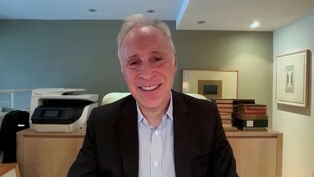
New“Profiles in Cowardice” Author on How Trump Got Powerful Leaders to Back Down
Video has Closed Captions
Jacob Weisberg discusses his new book "Profiles in Cowardice." (17m 48s)
Providing Support for PBS.org
Learn Moreabout PBS online sponsorship New Episode
- News and Public Affairs

Top journalists deliver compelling original analysis of the hour's headlines.

- News and Public Affairs

Today's top journalists discuss Washington's current political events and public affairs.








 New Episode

Support for PBS provided by: