
Farm Bill Advances, Cattle Rebuild Plan, Dirt Track Economics and China Trade Talks
Season 52 Episode 5205 | 26m 45sVideo has Closed Captions
Farm Bill progress, cattle herd rebuild, dirt track economics and a pivotal China summit for grain.
The Senate Agriculture Committee advances the Farm Bill as SNAP disputes cloud the path. Cattle prices sit near record highs even as the national herd hits a 75-year low. Rural Iowa's dirt tracks reveal a surprising economic value. Karen Braun examines how the upcoming U.S.-China summit is driving corn and soybeans, while the Black Sea conflict keeps wheat on edge.
Problems playing video? | Closed Captioning Feedback
Problems playing video? | Closed Captioning Feedback
Market to Market is a local public television program presented by Iowa PBS
Farm Bill Advances, Cattle Rebuild Plan, Dirt Track Economics and China Trade Talks
Season 52 Episode 5205 | 26m 45sVideo has Closed Captions
The Senate Agriculture Committee advances the Farm Bill as SNAP disputes cloud the path. Cattle prices sit near record highs even as the national herd hits a 75-year low. Rural Iowa's dirt tracks reveal a surprising economic value. Karen Braun examines how the upcoming U.S.-China summit is driving corn and soybeans, while the Black Sea conflict keeps wheat on edge.
Problems playing video? | Closed Captioning Feedback
Where to Watch Market to Market
Market to Market is available to stream on pbs.org and the PBS app.
Providing Support for PBS.org
Learn Moreabout PBS online sponsorship[PAUL YEAGER] Coming up on Market to Market, the farm bill finally gets a green light from the Senate Agriculture Committee.
Beef producers look for a path to rebuilding the herd.
The thrill and tradition of dirt track racing and commodity market analysis with Karen Braun next.
♪♪ [ANNOUNCER] I wouldn't be here without my customers.
Yeah, I'd like to thank the customers.
They're very dear to our hearts.
It's about the people that you're working with and the relationships that you have.
Thank you.
Thank you.
Thank you.
Thank you from the bottom of my heart.
♪♪ [ANNOUNCER] Family owned and operated for more than 60 years.
Sukup Manufacturing is a full-service provider of grain handling, storage and drying equipment, helping farmers feed and fuel the world.
♪♪ [ANNOUNCER] Tomorrow, for over 100 years, we've worked to help our customers be ready for tomorrow.
♪♪ Trust in tomorrow.
Information is available from a Grinnell Mutual agent today.
[ANNOUNCER] Support for Market to Market has been provided by a bequest from Philip Lietz of Alta, Iowa, in recognition of public television's commitment to agricultural programing.
[ANNOUNCER] Market to Market is made possible in part by a grant from the Corporation for Public Broadcasting.
[ANNOUNCER] This is the Friday, September 18th edition of Market to Market, the Weekly Journal of Rural America.
[YEAGER] Hello, I'm Paul Yeager.
At the Federal Reserve's FOMC meeting, the committee voted to raise the benchmark interest rate this week.
This is the first increase in more than three years.
The quarter point hike will likely push up the cost of borrowing for mortgages, credit cards and personal loans.
Nerdwallet's national average for a 30 year fixed Apr was 7.05%.
Friday.
Retail sales added 1.2% in August, the Commerce Department data reveals the resilience of the American consumer.
The price for diesel fuel stayed above $6 for the week.
Friday's reading from AAA was a record at $6.45 a year ago.
That price was $3.75.
The September Rural Mainstreet Index from Creighton University dipped below growth neutral.
The survey of bank CEOs in ten states dependent on agriculture and energy, dropped almost six points to a reading of 44.7.
Farm equipment sales continue to be a drag on the regions surveyed.
The 119th Congress returned to Washington, D.C., this week.
The House was in session for three days before adjourning until November 9th.
The farm Bill emerged from the Senate Agriculture Committee after a vote failed back in August.
The legislation heads to the full chamber in an attempt to get a full deal done, and not just another temporary extension.
Peter Tubbs reports.
[NARRATOR] This week, the Senate Agriculture Committee moved the 2026 farm Bill out of committee, advancing on a 12 to 11 party line vote.
Republicans promoted the inclusion of language to allow year round sale of E15 mandatory country of origin labeling and the reauthorization of conservation, Reserve and rural development programs.
Democrats objected to the timeline for implementing state level penalties to reduce the accounting error rate for Snap funding.
States are having difficulty meeting new paperwork requirements, which became law in May as part of reconciliation.
Observers believe that separating snap spending from the main farm Bill will make passage more difficult.
[JONATHAN COPPESS] Farm Bill since 1973 have had the food assistance and farm assistance in place.
Together and importantly, to maintain that coalition.
We had this thing we sort of commonly called it the cardinal rule of the farm bill.
You don't cut food assistance to boost assistance to farmers or vice versa, and you kind of abide by that.
[NARRATOR] The final vote on the farm bill may not happen until after the election, and votes during lame duck sessions are hard to predict.
[JONATHAN COPPESS] So you always have to say, well, this this bill isn't quite so controversial.
It's what they did last year that set this up.
That is the controversy and the problem.
So, it's like we're paying for that controversy of last year's decisions in this year's bill.
[NARRATOR] Funding for most sections of the farm bill runs through the end of the year.
For Market to Market, I'm Peter Tubbs.
[YEAGER] Consumer demand is still strong as cattle prices are near record highs and haven't dipped below $200 since January of 2025.
The government has vowed to help in rebuilding America's cattle herd, the lowest in decades.
Years of drought and input costs have forced family farms to make tough decisions, which include liquidation.
Now comes calls for federal policies to assist those producers.
Laura Bauer has the story.
[BRYAN WHALEY] In the last month alone, we've seen suspension of tariffs on foreign beef imports causing substantial volatility and uncertainty in our markets.
We also had a closure of a major meat processing plant in Illinois, where over 50% of the cattle that were processed in that plant originated from Iowa.
[NARRATOR] In the face of steep financial barriers and volatile federal policy blocking easy entry into the cattle industry, the Iowa Cattlemen's Association rolled out its 2027 legislative framework under the title Building Iowa's Cattle Future.
The policy focuses on creating stability and access into the industry, as well as promoting expansion of the cattle herd.
[CRAIG MOSS] We believe that Iowa is really situated to rebuild the American cow herd, which is at a 75 year low.
Iowa has a vast array of resources, a vast array of different types of ground and topography.
Iowa typically raises a crop, and we feel that these are synergistic things that all work together to support Iowa's cow herd.
[NARRATOR] The association is calling on state lawmakers to modernize the beginning farmer loan program, increase access to capital, and expand tax credits to help a new generation acquire livestock and land.
The plan also demands a reduction in the cost of permits and expansion of regional meat processing capacity and protection for agricultural land against eminent domain.
[CRAIG MOSS] Certainty is what's really lacking in this deal, and if we can provide a strong market and a strong business environment in the state of Iowa and illustrate that those producers are wanted and needed here in Iowa, that will help as much as anything.
[NARRATOR] For Market to Market, I'm Laurel Bauer.
[YEAGER] NASCAR runs Saturday night at Bristol Motor Speedway in Tennessee.
It is in the top five of shortest tracks on the circuit at just over half a mile.
And it even spent some time a couple of years ago as a temporary dirt track.
An average local dirt track found at your county fairgrounds is smaller than size, or it's even smaller than that from the pro circuit to the weekend recreational races.
Teams spend the week under the hood tuning up a winner.
When the lights come on for race night, the adrenaline peaks for fans and their favorite driver behind the wheel.
John Torpy has our cover story.
[NARRATOR] Underneath the fun and excitement surrounding the rituals of dirt track racing at local speedways.
Are the spinning wheels of economic good small town racetracks bring to their communities.
[KAREN BAILEY CHAPMAN] You know, oftentimes people think of racing as the big superspeedways, which we all see and know and love.
But the fact is that there's 1500 other smaller racetracks all around the country serving our communities.
And so.
[NARRATOR] Karen Bailey Chapman is a senior vice president at Specialty Equipment Market Association, an automotive industry trade group that supports motorsports to help shine a light on the fiscal importance of the sport, SEMA set out to quantify how weekly events at racetracks contribute to the economies of surrounding communities.
[KAREN BAILEY CHAPMAN] For every race car you see out there, there's parts that are being sold by manufacturers around the country.
There's venues that also employ people to make it all happen.
And then, of course, the outer part of, of that impact is, you know, from a hospitality perspective.
And so, we really wanted to, to really focus in on what the story behind the story is and the fact that it's, you know, I think there's a lot more that goes into what you see every weekend at your local racetrack than just the cars racing around.
[NARRATOR] According to a 2025 study by SEMA subsidiary Performance Racing Industry Motorsports, across the country contributes over $69 billion to the U.S.
Economy.
The study revealed that in Iowa, the total economic output of motorsports neared $1.7 billion last year.
[ANNOUNCER] Welcome to the high banks of Marshalltown.
[NARRATOR] In Marshall County, Iowa, home to Marshalltown Speedway.
Performance racing industry calculates the financial boost from motorsports to the community at more than $15 million annually.
You know.
[JERRY VANSICKEL] For 63 consecutive years, there's always been racing in Marshalltown.
It's always happened.
But these racers bring when they come to town, they're stopping at their gas stations.
They're stopping at restaurants.
It does impact the economics of the city.
[NARRATOR] With its high banked turns, the quarter mile Marshalltown Speedway is nicknamed the Bucket List Track, a track drivers want to race at least once.
The attraction to the oval track and its legacy have helped cement the Speedway's relationship with the city of Marshalltown.
[JERRY VANSICKEL] And we are lucky here.
We have a lot of community businesses that support the racetrack.
[NARRATOR] From replacement parts and fresh tires to fuel and food.
Owning and driving any race car can be an expensive investment, which often only yields the thrill of racing.
[JERRY VANSICKEL] Some of these guys have got, you know, 70, 80, $90,000 invested in their in their race car, which is, you know, for the weekly racer is a hobby.
It's not, you know, they're, they're not getting rich.
They're doing it to have fun.
They're doing it to they're passionate about it.
[NARRATOR] Vansickel adds the passion for motorsports can be seen as a linchpin.
Connecting the drivers and the fans.
[JERRY VANSICKEL] The reality is, you can't go drive a car at 100 mile an hour into a corner out on the street, but you can come and watch somebody here do it.
[PAT RACHELS] You don't really have the opportunity to sort of overanalyze stuff.
That's in a nutshell, why I love coming dirt racing.
[MUSIC] [JERRY MACKEY] So we appreciate you all coming out.
We appreciate you all being here.
We wish everybody the best of luck tonight.
[MUSIC] [PAT RACHELS] Pat Rachael's China Grove, North Carolina original hometown was Knoxville, Iowa.
I mean, the whole experience is awesome, right?
I mean, I love everything about it.
I mean, my favorite part probably is in, in the heat of the race.
Everything happens fast.
You don't really have time to weigh your options, right?
It's you just, you're just making decisions and going things flying.
Things are flying at you.
And it's always different.
Every lap is different.
That's probably my favorite part about it.
[NARRATOR] Pat Rachels is a second generation owner driver who had a hold of a steering wheel before he could walk.
Rachael's has carried his love of racing into adulthood.
As a senior engineer for Toyota Racing Development in North Carolina, his work supports multiple teams in NASCAR and other professional Toyota Racing crews.
When the opportunity presents itself, Rachael's finds his way to his favorite dirt track in the country, the Southern Iowa Speedway.
[PAT RACHELS] So it's almost two completely different worlds.
At the NASCAR level, everything is so fine-tuned and there's so many people and resources behind a single car.
Millions of dollars and, you know, tens or hundreds of engineers and mechanics.
At this level, it's you and a couple of your buddies do it all.
You just have to go with it.
You know, you make it work and you get to the racetrack and, and, and everybody at the racetrack is in the same situation.
When you race, you know, at a local level like that.
And that really makes camaraderie tighter because, because everybody's living what you're living to get to the racetrack.
And so, you end up developing some really good friendships.
[JERRY VANSICKEL] You know, racing is about family.
If you've got a racetrack in your community and you've always thought, I why should I go?
Just go to support it.
It supports community.
It supports the people that are passionate about it.
And a lot of times it is a business and it supports that business and it keeps that avenue open for the people who really enjoy it.
Every week.
[NARRATOR] For Market to Market, I'm John Torpy.
[ANNOUNCER] Next, the Market to Market report.
[YEAGER] Limited movement this week in the trade as harvest pressure starts to intensify for the trading week ending September 18th.
The nearby wheat contract lost $0.11 and the December corn contract fell $0.03.
The soy complex had three big influences from Oil meal and next week's summit between the U.S.
And China.
The November soybean contract added $0.07 and December meal gained five.
80 per ton December cotton shed $4.93 per hundredweight.
October class three milk futures declined by $0.45.
The livestock complex was lower.
October cattle fell by three.
75th October feeders cut $9 and the October lean hog contract lost $3.43.
In the currency markets, the U.S.
Dollar Index found 111 points.
October.
Crude oil increased by $0.83 per barrel.
Comex gold expanded by $30.20 per ounce, and the Goldman Sachs Commodity Index was even to settle at 75232.
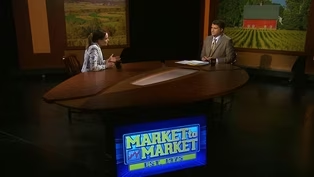
Here now to lend us her insight on these and other trends is regular market analyst Karen Braun.
Hello, Karen.
[KAREN BRAUN] Paul, it's great to be here with you again.
[YEAGER] This week did not have the volatility it had.
And it didn't even really have a whole lot of air coming out of the markets however.
What's that old phrase lack of news means we're likely going to go lower.
Is that do you think the overall theme this week.
[BRAUN] As you know, I think that we're in that place between we got the USDA report and now we're waiting on that summit that's happening next week between Trump and XI.
And so, I think that we just really need to know the results of that meeting.
We've been waiting for months for developments on this.
We've been waiting for months to see if the tariffs are going to the additional tariffs are going to come off, whether China is going to come in and buy more than just soybeans, because they've been doing a good job with the soybeans.
But we're looking for other stuff.
And I think corn.
Corn is the big one that I think has been on everyone's radar.
So, I think that's why we're kind of hanging out, you know, post USDA report but pre-summit.
[YEAGER] Speaking of conversations, the Ukraine and China and Russia having their conversations about, you know what, let's not hit infrastructure.
The wheat market seems to take that as what right now because again, movement was limited in that commodity.
[BRAUN] You know what that that's an interesting question because, you know, like you said, Ukraine and Russia said we're not going to hit each other's energy infrastructure.
And what did they do the next day?
They hit the energy infrastructure.
And I think, you know, looking at what's going on now and how the shipments really are limited from the Black Sea.
I think the difference between now and when this first started in 2022 is that in 2022, Ukraine's exports were completely shut off for months because of all the damage that they sustained.
And it was just unsafe to, you know, get in and out of the Black Sea.
But now, but Russia was pretty much untouched.
I mean, you know, there were sanctions and, you know, economic barriers.
But this time, Russia's infrastructure is damaged as well.
And that's a different.
And that's going to be a more long term kind of effect here.
Once, you know, they agree to make peace or, you know, stop the attacks, it's still going to take a minute to get things, you know, functioning back like they were.
[YEAGER] Let's go to corn because the fundamentals appear to be pretty darn good there for seeing some exports, seeing some maybe a little bit of rain dryness in other parts of the you got a whole lot of factors.
What's the biggest one for you?
[BRAUN] Oh my gosh, that your list your list was long.
But I could add like ten more things there that I think the corn market is looking at right now.
I think for me, people are still questioning, all right, did USDA reduce corneal enough?
How much lower?
And you know, we're just starting to get some reports out of the fields now.
And yeah, it's been raining in parts of the central Corn Belt this week.
So, I don't think harvest has advanced maybe as quickly as it appeared like it would.
But two results that I heard this week, both in Indiana, southeast Illinois, people out there, you know, collecting corn and beans actually in both were disappointing versus what was expected.
And I think that dry finish that kind of snuck up in August after what was almost a record wet summer in many areas, Illinois, Indiana, Ohio.
So, I think that that dry finish and warm finish may have taken a little bit off here at the end, but again, that's just a couple reports, right?
[YEAGER] So, it's even different from when you were out in the on crop tour just a month ago.
And, and there's people looking at the number that came up from where you were at.
If maybe we didn't go low enough.
So, moving forward with that information, if I'm sitting at home right now, what am I looking at to maybe do next week, given I know you're not going to give me direct advice, but what are the things I need to watch?
[BRAUN] Well, I think that watching what needs to be watched ahead of this meeting is just kind of how much how much risk is taken out, you know, going into this meeting because even today, you know, I think that Bessent was going to be meeting with his counterpart just this weekend to talk preliminary stuff.
And I think you may have seen a little bit of, you know, little bit of risk off.
I mean, the risk that's on is incredibly high.
I mean, funds are record bullish corn, soybeans, soybean meal collectively across the grain and oilseeds complex.
So, I mean that's pretty risky.
It's a risky position to be carrying into a meeting that really you know, I think people have been anticipating for months, years maybe.
And so, I wouldn't be surprised if you kind of see people get a little bit, you know, tense or nervous or pull back a little bit.
I wouldn't expect big changes before that meeting because again, we really need to know what's going to happen.
But especially this weekend, if something were to happen with, you know, those preliminary talks.
I mean, the market's going to be overly sensitive to every word.
[YEAGER] Okay.
That's what I was going to ask is how.
Because it doesn't seem to be that this week the market was sensitive.
And so, moving forward next week again, which smoke signals speak the most to us right now, that could come in the soybeans specifically.
[BRAUN] Could come in soybeans.
Well, I mean, leading up into the meeting, I think continuing to hear results out of the fields because I think the rains right now also are putting a little bit of moisture back into some of those bean fields that have dried out way too quickly after a hot and dry finish.
But yeah, I think that people are pretty pleased with how the Chinese purchases have been going with soybeans.
I mean, they seem well on their way to the 25 million metric tons.
And, you know, they continue purchasing routinely every week.
And so, I think there's no reason to believe they're not going to be fulfilling that.
But at this point, I think it's not about soybeans.
We now need more, you know, concrete information about what China plans to do beyond the soybeans, because we had that information back in the spring.
We were given that carrot.
And actually, they've really done nothing since.
[YEAGER] So, let's take China and take the weather out of the soybean equation.
Give me the meal and the oil story and how that may be propped things up in different directions this week.
[BRAUN] Oh my goodness.
Yeah.
Meal is just meal has just rocketed.
Right.
And I think, I think that it's really hard though to separate.
I think it's hard to separate those two right now from soybeans directly.
And also, you know, you've got what's going on in energy right now.
You know, in soybean oil is very much tied to that.
And we're also looking at crush data, right?
So, we just have so many factors that I think are coming at the soybean complex right now.
But, but, but I, but I think that, and I'm not really sure about the products in this upcoming week, because that's not really the focus of, you know, this trade summit.
And you know, what we're going to be focusing on this week.
So, I'm really all about the soybeans this week.
I think it's a make or break week potentially for soybeans.
Just in terms of the relations that we have with our biggest buyer.
[YEAGER] Let's look at livestock.
If we could.
The cattle on Feed Report 102 on feed 91 place, 97% fed, which number is the headline for you?
[BRAUN] I think the placements because that's, you know, way lower than expected.
I think we were expecting about 97%.
And so, you know, you see 91%, I think that that's just going to confirm that this tight supply story isn't ending anytime soon.
You know, we're not we're going to stay tight.
There's not a there's not a light at the end of the tunnel just yet.
And I think that, you know, I don't know if the cattle market wants to reflect that, because I know that we have been getting more imports in that may have finally, more beef imports.
And I think that may have finally calmed things down a little bit.
But this report is supportive of for the narrative that we have been talking about extensively for the last year.
[YEAGER] And the live cattle market.
I mean, we see movements again, one way heavy, one way another.
And we had it just since we last recorded last Friday.
So is that still going to just be the norm here for the near term big movements.
[BRAUN] It could be.
And I mean this year has been really heavy cattle news right.
And any time that any commodity gets attached to politics, even then all bets are off.
Right.
So, so I think, I think that the fact that we haven't heard a lot of that headline news lately, you know, that we're waiting for direction, right?
We want to know, are we are we going to increase imports?
Is the government going to help us rebuild the cattle herd?
And how right are we going to continue to reopen points along the US-Mexico border?
And how is that going?
Are we containing screwworm?
You know, all of these factors?
I think it's really like a hurricane of factors.
[YEAGER] Real quick with hogs on a few seconds.
We're still at 12 month lows.
Any light at that tunnel?
[BRAUN] You know what?
Last time I was here I was talking about how funds don't like to stay short hogs.
And you know what?
They've stayed short hogs this whole time.
And, you know, I just think that that that just really reflects on the persistence of that bearish story.
And the supply is ample, you know, and people like beef more than pork right now.
[YEAGER] All right.
Karen, great to see you.
Thank you so much for your time and insight.
[BRAUN] Yes.
[YEAGER] Karen Braun everybody, you've been watching and listening to our market analysis.
If you are watching us online or on the PBS app, we are going to stay here and continue this discussion and Market Plus, our online only segment.
Find it wherever you get your podcasts or at markettomarket.org to watch, listen, or read.
Last week, many of you had strong reactions about one of our stories.
See what others are saying and you can weigh in with your thoughts on facebook.com/markettomarketshow.
Next week a story of passing the dairy to the next operator.
Thank you so much for watching.
Have a great week.
♪♪ [ANNOUNCER] Market to market is a production of Iowa PBS, which is solely responsible for its content.
♪♪ [ANNOUNCER] I wouldn't be here without my customers.
Yeah, I'd like to thank the customers.
They're very dear to our hearts.
It's about the people that you're working with and the relationships that you have.
Thank you.
Thank you.
Thank you.
Thank you from the bottom of my heart.
♪♪ [ANNOUNCER] Family owned and operated for more than 60 years.
Sukup Manufacturing is a full-service provider of grain handling, storage and drying equipment, helping farmers feed and fuel the world.
♪♪ [ANNOUNCER] Tomorrow, for over 100 years, we've worked to help our customers be ready for tomorrow.
♪♪ Trust in tomorrow.
Information is available from a Grinnell Mutual agent today.
[ANNOUNCER] Support for Market to Market has been provided by a bequest from Philip Lietz of Alta, Iowa, in recognition of public television's commitment to agricultural programing.
[ANNOUNCER] Market to Market is made possible in part by a grant from the Corporation for Public Broadcasting.
 New
NewAcre Decisions Loom, China Talks Have Bullish and Bearish Potential In Market Plus with Karen Braun
Video has Closed Captions
Clip: S52 Ep5205 | 12m 30s | Karen Braun weighs the 2027 acreage battle, input costs and U.S.–China trade signals. (12m 30s)
Providing Support for PBS.org
Learn Moreabout PBS online sponsorship New Episode
- News and Public Affairs

Top journalists deliver compelling original analysis of the hour's headlines.

- News and Public Affairs

FRONTLINE is investigative journalism that questions, explains and changes our world.
 New Episode
 New Episode
 New Episode
 New Episode
 New Episode
 New Episode


 New Episode

Support for PBS provided by:
Market to Market is a local public television program presented by Iowa PBS