
Inside the Museum Saving LA’s (Historic) Neon Signs
Clip: Season 9 Episode 3 | 11m 31sVideo has Closed Captions
Discover how neon signs preserve LA’s cultural history.
Neon signs once defined the visual landscape of Los Angeles. At the Museum of Neon Art, these historic signs are restored and preserved as cultural artifacts. This segment explores how neon reflects the stories of neighborhoods, businesses, and communities, capturing the evolving identity of the city through light and design.
Problems playing video? | Closed Captioning Feedback
Problems playing video? | Closed Captioning Feedback
Lost LA is a local public television program presented by PBS SoCal
Inside the Museum Saving LA’s (Historic) Neon Signs
Clip: Season 9 Episode 3 | 11m 31sVideo has Closed Captions
Neon signs once defined the visual landscape of Los Angeles. At the Museum of Neon Art, these historic signs are restored and preserved as cultural artifacts. This segment explores how neon reflects the stories of neighborhoods, businesses, and communities, capturing the evolving identity of the city through light and design.
Problems playing video? | Closed Captioning Feedback
Where to Watch Lost LA
Lost LA is available to stream on pbs.org and the PBS app.
Providing Support for PBS.org
Learn Moreabout PBS online sponsorship-For decades, Los Angeles laid claim to a proud piece of neon history.
In 1923, as the story goes, a businessman named Earl C. Anthony installed two glowing signs in downtown LA to advertise his Packard car dealership, the first neon signs in America.
Neon enthusiasts Dydia Delyser and Paul Greenstein decided to go looking for the evidence.
-I just started looking everywhere at UCLA and the geography department.
I knew about the Air Photo Archive, so I went there because this sign supposedly was on the roof of a building at the corner of 7th and Flower.
-After layering aerial photographs of the same location taken over successive years, Dydia discovered no evidence of a neon sign at that corner until 1925.
-It's not the first one.
It's not in 1923.
-Who was first?
-Ingersoll.
They were a lot earlier.
This is a replica of the first commercial neon sign anywhere in the world.
-It wasn't in LA?
-It wasn't in Los Angeles.
This was made in Newark, New Jersey in 1909.
-1909, so it's not even close.
-It's not even.
It doesn't even matter if it's '23 or '24 or '25.
It's not even close.
-You dispelled this myth, but I don't know if the internet has noticed because if you Google first neon sign in America, it says the first neon sign in America were two Packard signs installed by Los Angeles car dealer Earl C. Anthony in 1923.
That's right.
That's the Google AI overview.
-The AI plagiarist is still drawing from all those same sources.
It's incredibly difficult to overturn a myth that has been so widely established.
Now, AI is making that even harder.
-Old myths die hard.
Even if Los Angeles wasn't the first to embrace the glow, it did more than make up for lost time, ultimately earning a reputation as the City of Neon.
The collections of Glendale's Museum of Neon Art make a pretty compelling case.
Neon is something that has become part of the visual fabric of the city.
It still is today, and yet it's something that it really pops.
It's bright color, and yet sometimes we don't take notice of it.
How is that possible?
How can you square that circle?
-It's such an interesting thing because it's highly visible.
It's designed to be visible, but it also has become so much a part of our lives that it disappears in plain sight.
-There is this common misconception, or we could say myth, that Los Angeles was the originator of neon in the United States.
-Los Angeles is in many ways associated with neon.
We came of age when neon was really the height of technology, the height of class.
We have a lot of neon from there.
-I see some signs around here.
Some of these are spectacular.
Some of them seem to represent some of the more pedestrian ways we see neon.
You'll always see these vacancy or no vacancy signs, and then I think probably the most common neon sign that I see, at least, are beer signs.
I love that here you have an old classic and sadly retired LA beer brand, Eastside.
-Yes.
If you're familiar with the Brewery Art Colony, that's where Eastside Beer comes from.
That's pretty exciting that we have that piece of LA history.
-I take it that this is one of the older signs that you have?
-Yes.
This is a sign from the 1920s from Lincoln Market.
It was in Pasadena.
It was a Japanese-American establishment.
-What is distinctive about this sign that tells its age?
-When this sign was built, neon was really classy.
You would guild the edges of it, basically.
We have all these flourishes here.
Then the text itself is raised from the sign.
In the 1920s, they thought, "Okay, how do we make our signs visible?
We're going to build them out so you can read them."
Then as time went by, they realized we can just paint it and it's visible enough.
-The people who made these signs, were they thinking that they were making public art, too?
-There was a lot of pride in the people that made these signs.
Even when we take down a sign, people will stop by and they'll say, "My grandpa worked on this.
I know someone who knows someone who worked on this."
It becomes this collective art piece.
They're creating some of the biggest monuments we have in Los Angeles.
It's this humble, maybe just to advertise food or something like that, but it gives meaning to a neighborhood and to a community.
Also, a lot of immigrant communities asserted their Americanness, their contemporariness by having neon signs.
It became part of each person's identity.
-You have other examples of that around here, too?
-Definitely.
We have a really strong collection of neon from Little Tokyo.
I can show it to you if you want to see.
-Yes, let's take a look.
-Both of these signs are from Little Tokyo.
We have Matsuno Sushi, which some people say it was the first sushi restaurant in the United States.
I love the aesthetics of the sign.
-Neon arrived with a bang, and it was a big phenomenon.
You'd see it all over the city, but eventually, it went out of fashion.
-That's right.
There's a lot of different reasons for that.
One is during World War II, because there were air raid fears, a lot of signs were turned off.
Neon can last for a really long time.
It can last for over 100 years in the tube, but the transformers, they don't last as long.
When World War II ended, there's a lot of flickering signs.
You can think about noir film, It's a Wonderful Life, these people with a Mid-Atlantic accent saying, "You can tell by the look of the place it was no good in the flickering neon."
There's that aspect and association.
Alongside that, there's also this boom of neon.
After World War II, a lot of people took the GI Bill, and they learned how to make neon signage, because neon was a pretty reliable way to make income.
Even during the Great Depression, the US government actually incentivized making your storefront modern, and they paid for people to do neon projects.
A lot of soldiers came back from the war, and they thought, "Oh, this is an honest living that I can make for my family.
I'm going to learn how to make a neon sign."
Neon signs exploded, but also connotations with Las Vegas and nudity clubs and gambling.
There became this association with urban decline and immoral behavior.
The landscape became moralized and seen through this lens that neon was trashy.
-Some municipalities even banned neon?
-Yes.
There's the American Beautification Act, which across the United States was interested in taking down specific forms of signage.
Many different municipalities banned neon, including Glendale.
Glendale was a huge neon city.
You look at old historic photographs, and it's a fantasy of neon light, but all that was taken down in the '80s.
-Irony of ironies, we're here in Glendale in the museum that celebrates neon.
It's come around a bit, right?
Is it experiencing some sort of a Renaissance?
-Yes.
One thing that happened that I think is really beautiful, it's about the way we see history and about the power of artists, is in the 1980s, and actually even before that, '70s and '60s, artists were seeing that neon was becoming maligned.
Artists like Bruce Nauman, Mario Merz, other people were using neon.
Other people were using it to say something about their place within culture.
Also, a lot of people in counterculture, a lot of people in the LGBTQ community were embracing the signage that was being discarded.
That's when Melrose came into being.
The war baby sign behind you, that was from a boutique in Melrose.
Neon became punk.
Neon became counterculture.
Neon became cool because it was not cool.
Artists started taking and saving it.
That's the origin story of the Museum of Neon Art.
A bunch of artists, a bunch of outcasts that saw something that was being forgotten by culture, and they wanted to save it.
-Before it became an urban spectacle, neon was a laboratory curiosity, a gas so rare it took decades to harness.
It's a story that begins more recently than you might expect.
When was the gas discovered?
-The gas was discovered in the late 1890s by these two scientists, but it was so hard to process that it was really unavailable.
-It's interesting, though, that this is a gas that in some ways is part of just the visual fabric of the 20th century, neon.
It's hard to imagine the 20th century without neon, but it wasn't discovered until the 1890s.
-The rise of neon is in conjunction with the rise of cars, which is the 1890s.
It's around the same time.
They both fed off of each other.
-A happy coincidence in some ways.
-Yes.
What we have here is we have a sign that's probably from the early '30s.
It says radio, and you see it has a big radio lightning bolt through it.
-I love that lightning bolt.
Isn't that cool?
-It's really a nice one.
Meanwhile, what I've brought is I've brought the repaired piece of glass.
If you don't mind doing a little do-si-do-- -Yes, let's do it.
---let's switch it over.
I'm going to ask you to put your hand right here and hold it.
-Right here?
-Yes.
Then I'm going to wire this one up.
Now we're going to do-si-do again.
Let's switch sides.
We're going to do the same thing over here.
-This is not plugged in right now?
-This is not plugged in right now because you'd see me dancing.
Because this sign is really old, originally, the connectors were made with things called a Fahnestock clip, which radio people will know what that is.
It's a little spring clip that connects wires.
We're using copper wire.
Some people use steel.
Copper is the only thing that really works well.
You make a loop.
You're going around the ear on this.
-Oh, like that?
-Yes.
-Oh, I see.
-Now, you cross over with the long one.
Now, just as a bellwether, these type of glass stands were invented in 1927 in Long Beach, California, and they are still in use today.
-Wow.
Made to last, huh?
-Made to last.
Now, there's no guarantee that this will work because I have never tested this sign out.
-Woah.
-Hey, it works.
It's just electrons moving, and that's what we see as light.
-The electricity is just exciting the gas inside?
-Correct.
It shouldn't ever leak.
Theoretically, this is good for 100 years, 200 years, 300 years, nobody knows.
Now, you fixed your first neon sign.
-All right.
Thanks for letting me have a hand in it.
-Sure.
No problem.
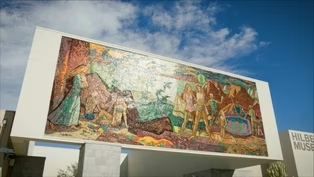
How did this Massive Mosaic from Santa Monica End Up in the OC?
Video has Closed Captions
Clip: S9 Ep3 | 7m 24s | A monumental mosaic saved from demolition and restored piece by piece. (7m 24s)
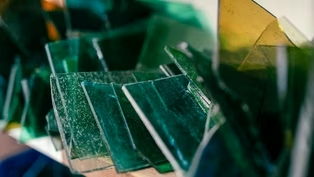
Inside Judson Studios, LA’s Historic Stained Glass Workshop
Video has Closed Captions
Clip: S9 Ep3 | 7m 42s | The stained glass studio that's infused SoCal architecture with color for 125 years. (7m 42s)
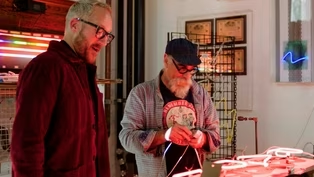
Neon, Stained Glass, Mosaics: Hidden Backdrops of SoCal
Video has Closed Captions
Preview: S9 Ep3 | 30s | Hidden in plain sight, neon, mosaics and stained-glass shaped Los Angeles’ backdrop. (30s)
Providing Support for PBS.org
Learn Moreabout PBS online sponsorship











Support for PBS provided by:
Lost LA is a local public television program presented by PBS SoCal