
Feb. 3, 2026 - Full Show
2/3/2026 | 26m 48sVideo has Closed Captions
Watch the Feb. 3, 2026, full episode of "Chicago Tonight."
Illinois weighs joining a new school voucher program. And we’re one on one with CPD raid survivor Anjanette Young.
Problems playing video? | Closed Captioning Feedback
Problems playing video? | Closed Captioning Feedback
Chicago Tonight is a local public television program presented by WTTW
WTTW video streaming support provided by members and sponsors.
Feb. 3, 2026 - Full Show
2/3/2026 | 26m 48sVideo has Closed Captions
Illinois weighs joining a new school voucher program. And we’re one on one with CPD raid survivor Anjanette Young.
Problems playing video? | Closed Captioning Feedback
How to Watch Chicago Tonight
Chicago Tonight is available to stream on pbs.org and the free PBS App, available on iPhone, Apple TV, Android TV, Android smartphones, Amazon Fire TV, Amazon Fire Tablet, Roku, Samsung Smart TV, and Vizio.

WTTW News Explains
In this Emmy Award-winning series, WTTW News tackles your questions — big and small — about life in the Chicago area. Our video animations guide you through local government, city history, public utilities and everything in between.Providing Support for PBS.org
Learn Moreabout PBS online sponsorship>> Hello and thanks for joining us on Chicago tonight.
I'm Brandis Friedman.
Here's what we're looking at.
>> We do not want That's a program will take away public schools.
>> Illinois could join a new federal voucher program to fund scholarships for private schools.
What that could mean for education in the state.
Plus, Anjanette young survived a botched police raid on her home.
Now she's sharing her story in a new book.
>> First off tonight, the partial government shutdown comes to an end as Congress members now consider possible reforms for the Department of Homeland Security.
This as a Chicago woman who survived 7 bullet wounds at the hands of a Border Patrol agent last fall told her story to members of Congress on Capitol Hill today.
>> Friday, Ellis teaching the young children at the Montessori school and we were singing and dancing and getting ready for spooky season for prayer, preparing fall activities to do the following week.
And I'm sorry to government was clear to me a domestic terrorist and I was in federal detention centers.
With the bullet holes all over my body the House or the Senate Martin.
Marty Martinez described early October when her car was struck by federal immigration agents Brighton Park neighborhood.
>> She told Congress members today she had been following the SUVs and blowing her horn to alert her neighbors that agents were in the area.
Martinez was later charged with assaulting the agents who shot her.
But those charges were dropped by the U.S.
attorney's office.
federal judge is expected to rule tomorrow on whether to unseal the photos and videos from the incident as Martinez and her attorneys have requested to combat what they claim is the harm being done to her reputation.
Also testifying before the joint House and Senate committees today.
The brothers have Renee Nicole, good killed by federal immigration agents last month and the families, Chicago based attorney.
The first month of 2026, shows crime numbers in Chicago are continuing their downward trend from 2025, the Chicago Police Department says there were 29 homicides in January this year.
That's 29% less than the 41 in January of last year.
Also, robberies are down 31% since the start of the year and shooting incidents down 10%.
Just as the U.S.
exits from the World Health Organization.
The state of Illinois is joining the WHO is global outbreak alert and response Network Governor JB Pritzker's office says the coordinated International Network is dedicated to monitoring and responding to global disease outbreaks by joining Illinois.
Public health officials will have a direct line to the organization's global alerts and expert public health networks.
The state says joining the network will strengthen the Illinois.
It will strengthen the state's preparedness for future pandemics and emerging threats.
Northwestern football fans looking to cheer on their team from their new stadium will have to wait a few weeks into the season.
That's because the Wildcats will not be debuting the new Ryan Field until week.
4 of the season when they host their Big 10 home opener against Penn State.
The opening of the new 862 Million Dollar 35,000 seat stadium in Evanston is now scheduled for October.
2nd, the Wildcats will play their first 2 home games at their temporary lakefront Stadium location there.
Lakefront location at Martin Stadium.
How a controversial new program could change education and Illinois right after this.
>> Chicago tonight is made possible in part why the Alexandra and John Nichols family.
The Pope Brothers Foundation.
And the support of these donors.
>> Illinois is among several states deciding whether to opt into a new federal school voucher program under the program, which was passed by Congress in the so-called Big Beautiful Bill Act.
Donors can give up to $1700 to nonprofits warning K through 12 scholarships and receive an equivalent amount back in federal tax credits.
Scholarships can be used to help pay for private school tuition along with some out-of-pocket expenses for public school.
Families.
Like during or after school programming.
28 states have opted into the program so far most of which are Republican lead the 4 states that have said no to the program.
Are Wisconsin, New Mexico, Oregon and Hawaii and are all led by Democratic governors.
Governor JB Pritzker has yet to decide whether he'll opt the state in saying last week he was still waiting on program rules from the federal government.
>> Just on its face, the question is, is just just just a repeat of trying to take money out of public schools and moving into private schools, which is what the Trump administration generally speaking has been in favor of or is this something that could be useful?
But we just don't know because there are no rules around it right now.
>> Joining us to talk about this are and quarter education issues specialist for the League of Women, Voters of Illinois and Austin Berg, executive director for the Chicago Policy Center at the Illinois Policy Institute.
Thanks to both of you for joining us to talk about this and quarter your organization.
You all are among that coalition of groups that signed a letter to Governor Pritzker urging him not to opt into this program.
What are your main concerns?
40 organizations have joined us.
We would like Governor Pritzker to stand up for public education, which is the backbone of our democracy.
>> We think this should not be a partisan issue.
Public schools are most important thing that helps our workforce and provide social fabric and especially in rural communities.
We are also working to educate citizens an opportunity to vote in non-binding referendum on March.
17th, about 10% of the population will be able to do that.
Our concerns are that there is no such thing as free money that this program will harm public education in Illinois for a variety of reasons.
We think that this is not designed to help low-income students.
We believe that this is wide open for waste, fraud and abuse.
And so we urge the governor to opt out.
>> Austin, you and your organization, you're in support of this federal program.
How come the states and students in the state benefit from it?
Well, this unlocks hundreds of millions of dollars for education in Illinois.
>> hundreds of millions of dollars that would otherwise go to D C or other states.
So that's why you see Governor Jared Polis, Democratic governor in Colorado say we would be crazy not to opt in.
I grew up in Illinois and remember seeing, you know, booster clubs right at the football game, selling snacks are doing bake sales to fund scholarships for after-school programs.
Imagine if every single one of those clubs in across Illinois could take a one for one dollar federal tax credit that unlocks tens of millions of dollars for public schools in Illinois.
And that's why I think you see 28 states going for that how the I mean?
I know we've got some some stuff to work out.
But is that how the program works?
Right?
Like, for example, if I donate to one of the scholarship >> providing organizations I can receive up to that amount back in a federal tax credit.
but then that is, is that necessarily unlocking millions of dollars?
Does that money has to come reporters?
Asians?
>> No, it it's imagine I could either send $1700 to Washington, D.C., or I could send that $1700 to my local school community.
And that could be public school private school after school tutoring any education expense.
So I really do think it's a rising tide lifts all boats.
And I agree with what was said before.
I don't think it should be a partisan issue.
That's why you see red blue purple states opting in.
>> there are comparisons being made to the invest in Kids scholarship program that was in Illinois at sunset a couple of years ago.
When we learn from that program heavy think it applies here.
It's a very comparable program.
The tax credits are even more generous in this program.
It's 100% tax credit.
So there is absolutely no skin in the game by the donor.
>> It's 100% federal money coming out of our pockets as taxpayers.
2 private religious schools invest in kids should saw that most of the money went to more well off families that went to private religious schools and I the were often not able to enter the school that they chose this schools who are part of that program, 50% did not have any students of color who are black and 30% did not have Latino students.
Only 15% of those schools provided special education.
So to have that much federal money coming back into the states who have system that is private and religious and is not going to provide civil rights and special education opportunities for students we think is a big mistake.
In this the federal government says that the money is not necessarily just for private schools and institutions.
Public school students could also use it for programming or >> other sort of assistance provided that they need the income qualifications.
The rules have yet to promulgated the law itself mention some possibility of some.
>> Tutoring services being provided for public school students.
But it been very clear from the Department Education that no money should go to supplement to to make the school budget any any less tight?
It provide possibility that students will not access to.
Things that they would get in a public school.
Special education rights need to be weighed.
They need to have their funding >> for >> And which language learners would not be available in private schools.
But the public's aspect of it we think is highly unlikely to really provide much of a boon for public schools because if you look at what the administration has done with public education in the last year, the President Trump proposed cutting 300 million dollars from the education money flowing into the state he has provided already cut a number grants.
>> So but also want you back in here because there are those who argue that, you know, they use of scholarship programs like this, that this takes money.
It funnels it towards private schools and that if students from public schools or leave in public schools to go to private schools and that takes money from those public schools.
Would you say to that argument?
But I think it's misinformation to pit this as public versus private.
This is about more resources for education.
Whatever works best for the kid.
So for some kids, it's going to be some forms of private education.
>> Other kids they might need summer school after school assistance.
That's why the Democratic governor of Colorado opted and he said would be crazy not to provide, you know, after school programs or summer school or extracurriculars either that money is going to the federal government or it's staying here coming back here to Colorado.
And that's what I really think the option is here do you want you're $1700 going to DC where would you like it to fund or local school community?
And I think people from all political stripes would prefer that money went to our local school communities.
>> There's you know, there's also some supporters make the argument that, you know, opting out of the program essentially leaves money on the table.
That could be supporting students.
How do you respond to that?
And believe that the money that goes to Washington should be coming back to Illinois to public schools should be providing after school programming and tutoring program in and fully funding the special education.
We think that if we accepted this money, it would not outweigh the the harm that would be caused by the private public voucher program.
It will divert billions of dollars away.
As as Alison mentioned, it will be a huge program.
It will divert that money away from the title.
One programs in the special Ed programs that that could be coming to our state.
It will divert because it there's no free money.
There's no such thing as a free lunch.
It comes from somewhere.
Every time I these things, your head.
So I mean, come back to haunt So says taking your questions.
Do we want to fund scholarships and other states with their federal tax money or do we want that money coming back to Illinois?
This is our money.
It's not DC's money and we shouldn't have to rely on the Trump administration to give it to us.
And that's where I think.
>> The more you oppose what the Trump administration is doing right now, the more you should support this program, your money is not going to the Trump agenda in DC it's going to your local school community.
>> And I think like all political stripes should be on board with this.
And that's why you're seeing again, Democrat state's Republican states.
I think it.
>> And the federal government, as we've said, they're still developing the specific regulations.
What are your concerns about the details that we don't know about yet?
>> For example, I think I agree that it's not partisan, but I think that it should nonpartisan the other direction.
I think that no one should should be supporting this program.
It's wide open for fraud and abuse.
You've got a 10% gets to be diverted to the scholarship granting organization from that money that is collected.
10 1% goes to an intermediary organization.
It's not an efficient use of funding.
also not designed to really help low-income students or students really at all.
Research shows that voucher programs do not result in higher student achievement, particularly for low-income students, wrist that barely caught cover entire cost attending private religious schools, even with a Boucher, there's transportation costs, tuition these books.
It's too expensive for most low-income families.
>> Before we let you go, just got a little bit of time left Austin, you know, the case for school choice.
It has always been there seems to be getting a boost from the Trump administration.
Why might some families choose not to send their kids to public schools?
Well, its not one size fits.
All right.
Not everybody wears the same size shoes.
So some kids need different kinds of services.
Maybe they live closer to a private school that their families comfortable with or maybe they have a program that they would be able to access elsewhere.
>> And I think it's really important and it is really a civil rights choice.
We saw Milwaukee generations ago lead the civil rights movement for school choice with Dr Howard Fuller, just, you know, a few miles away from where we are now.
And I think it remains a civil rights issue that every parent should be able to choose the education that's right for their child.
And I think this definitely supports that, but also supports public schools.
Okay.
That is where we'll have to leave it.
Obviously we will.
We still await the governor's decision on this and quarter and Austin Burke, thanks to both joining Thank you.
>> Up next, the Chicago woman at the center of a botched police raid.
How she's using her trauma to help others.
It's been nearly 7 years since social worker Anjanette Young's home was mistakenly raided by Chicago police.
A dozen officers stormed into her apartment without identifying themselves and ransacked the unit as she stood naked and handcuffed.
Tearfully pleading with officers if they have the wrong place.
Since then, the city has settled her lawsuit for 2.9 million dollars.
But she says the trauma persists.
Young details, the incident, the events that followed and her journey to healing in her new book past the pain, how to emerge from trauma with purpose, which is out today.
And joining us now is Anjanette Young.
Welcome back.
Thank you for joining us.
Thank you so much for having me.
And thank you for always giving me a space continue to tell my story and to uplift others.
We're glad you're here sharing your story because you've been outspoken since it happened.
Probably not something easy to do.
>> Why did you want to write a book?
I wanted to write a book really help others who left.
You can have my hit other trauma experienced as a parent and, you know, as a profession, I am a licensed clinical social worker and so is so important for people to understand what it means to experience trauma or deal with mental health.
And then also a lot of my book talks about how to you.
How do you navigate that?
How do you understand what your body is feeling?
It where the resources are important for you to connect was was a difficult when you got down to the riding part of it because obviously you probably have to relive the experience in some detail.
Was that.
>> was very writing, just getting it on paper was one process of it.
>> But when you actually get to the editing process and you have to go back more detail or give more emotion, the editing process was very hard for me.
And it was in those moments where I knew that I had to be intentional to take care of myself in order to get the book finished it.
So it's, you know, it's to live your life.
But then also to get the book finished as well on that because you talk about working to grow past the pain title of the book.
Of course.
>> And you share some advice of your therapist.
What some of that advice.
>> one of the things that I feel like my fear is help me with the most was understanding what I was feeling in my body.
So when you are triggered by almost 99% of the time you feel it in your body before you could understand it in your mind and so wanted.
I think the best thing my fear is help me with it was to understand what I was feeling in my body before my mic caught up to it to react to what I was feeling and share.
Some of those tips in the book as well because understanding which are fielding grounding yourself and finding a space to feel safe again so important for It makes me recall.
The book the Body keeps the score about impact of trauma and how that shows up in your body.
>> You also you created the I am her foundation following the death of Breonna Taylor.
We all know black woman who was shot and killed by police officers in her Louisville home during a botched raid even you look, you struggled with getting anyone to believe you before.
That video was released thanks to our colleagues with their help at CBS, 2 you know, why do you think people didn't believe you already think?
We often don't hear about the experiences of of women at the hands of police violence.
I feel like historically we hear so much violence and our cities and around our countries that until we actually see it for ourselves, sometimes.
>> It doesn't really register.
So initially with CBS, 2 my first interview.
We didn't have the body cam footage.
And so that story didn't get a lot of attention.
We told the story of what happened, but it wasn't until people are able to see it that actually register with them.
And unfortunately, because we're so inundated with stories about trauma.
And, you know, another person who has been harmed that oftentimes it doesn't register and actually see it.
And of course, none of us can forget that the emotion in your voice hearing and watching that video once it was released.
>> Since the incident you've been advocating for an ordinance to reform police search warrant policies.
There has been some progress changes made to CPD policy include verifying warrant information before execution, limiting the hours of search warrants that they are served to between 06:00AM and 10:00PM avoiding pointing firearms at were handcuffing children unless reasonably necessary documenting all search is on in crisis.
Trained officer must be present during the raids.
Now the PD is policy was finalized late last year.
No public notice.
You endorsed Mayor Brandon Johnson as a candidate because he promised to ban no-knock warrants.
Are you frustrated?
How do you feel?
I'm frustrated with the process.
Absolutely.
I'm also learning in this journey of being in this space.
>> That change doesn't happen overnight in that it's a marathon and not a sprint.
So while I'm disappointed that we're not there yet, I believe that there is still some interest from the mayor's office.
I've had great relationship Mayor Brandon Johnson.
And so it is always expresses commitment to find a way to move this forward.
And so I think that there is still some opportunity for us to do that.
And I am committed to the crisis until we get it.
Then creates change.
Doesn't happen overnight.
But over 70 years has learned it has been 7 years.
And although we have not passed the ordinance, they have been small incremental changes.
And so I'm okay that were seen little is like taking baby bison.
Like how do you eat elephant?
One bite at a time?
So there has been some change.
And so there is much more change that needs to happen.
And it's unfortunate that it's taken this as long hes.
Speaking of elephants, the consent decree it was it is elephantine rated as big an expanded to include search warrants because of because of what happened to you.
>> You had told us in the past that you are sort of disappointed with the consent agreement, but that it's not a whole solution had.
still feel let down by the consent decree process?
It feel about I feel the same way about the consent decree.
Very slow process and getting things done.
>> I pleased that I have had opportunities to actually speak with a federal judge.
It different public cares regarding my concern with the consent decree again is one of those things that is moving might like molasses.
But I am hopeful that we will start to see some change.
>> All you've also lobbied for change in state law for these restrictions.
Are you continuing that work as Absolutely.
So I'm very pleased with the work that I'm doing Representative Kam Buckner, others in Springfield.
We are still very much pushing forward.
It passed through committee.
I've had some conversations with him recently.
So we're looking at bringing it back to the table.
This in this session in Springfield.
So I'm very excited.
Then we still have some commitment and movement at the state level since Chicago Police Department's their residential search warrants have dropped nearly 83% from 1382 in 2019.
>> To 228 in 2025, that is pretty substantial.
What do you think?
That's a reflection of?
absolutely think it's a reflection of the work that I have done in the work of the community members who have stood with me.
>> The correlation Craig Futterman and his team does.
I think that's a reflection of the work that has been happening, that the numbers are reducing in.
So that's a move in the right direction.
Okay.
book is out now.
What's next for you?
The book actually was just me wanting to help people to understand what it means.
So they have with trauma and how to heal from trauma.
What's next for me right now is I am very excited that I have the freedom to go out and support other families who have had these experiences.
So I've had an opportunity to work with the song, a messy family.
I had an opportunity to go to DC and work with the Martin family who had a case in the Supreme Court round FBI raids in so even today I went over to the courthouse and I said with the Tate family who was started near trial around a roll rate.
So those are things that I'm most excited about moving forward.
unfortunate that there is a community of people who have experienced this.
But I think maybe the wind is that they have you and each other to to work together on on healing from events like this.
>> In Jeannette Young, thank you so much for joining us again.
Thank you.
Again, the book is called past the pain.
How to emerge from trauma with purpose.
And we're back to wrap things up right after this.
>> Reflecting the people and perspectives that make a buck This story is part of Chicago tonight.
Black Voice.
>> And that's our show for this Tuesday night.
Stay connected with our reporters and what they're working on by following us on Instagram at W T Tw Chicago and join us tomorrow night at 5, 30 10 now for all of us here at Chicago Brandis Friedman, thanks for watching.
Stay healthy and safe.
We have a good night.
>> Most caption News may pass by Robert a cliff and Clifford law Chicago, personal injury and wrongful death.
Right?
And
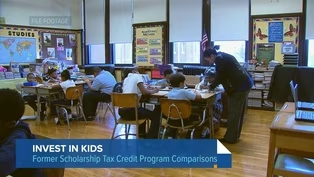
Illinois Could Join Voucher Program to Fund Scholarships for Private Schools
Video has Closed Captions
Clip: 2/3/2026 | 11m 8s | Gov. JB Pritzker is weighing whether to opt in to the federal program. (11m 8s)
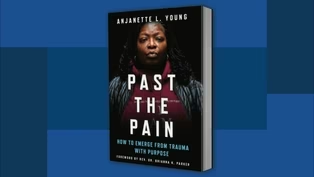
In New Book, Anjanette Young Shares Her Experience in Botched CPD Raid
Video has Closed Captions
Clip: 2/3/2026 | 9m 4s | A botched February 2019 raid left Anjanette Young handcuffed while naked inside her home. (9m 4s)
Providing Support for PBS.org
Learn Moreabout PBS online sponsorship
- News and Public Affairs

Top journalists deliver compelling original analysis of the hour's headlines.

- News and Public Affairs

FRONTLINE is investigative journalism that questions, explains and changes our world.












Support for PBS provided by:
Chicago Tonight is a local public television program presented by WTTW
WTTW video streaming support provided by members and sponsors.