
December 24, 2025 - PBS News Hour full episode
12/24/2025 | 57m 46sVideo has Closed Captions
December 24, 2025 - PBS News Hour full episode
December 24, 2025 - PBS News Hour full episode
Problems playing video? | Closed Captioning Feedback
Problems playing video? | Closed Captioning Feedback
Major corporate funding for the PBS News Hour is provided by BDO, BNSF, Consumer Cellular, American Cruise Lines, and Raymond James. Funding for the PBS NewsHour Weekend is provided by...
December 24, 2025 - PBS News Hour full episode
12/24/2025 | 57m 46sVideo has Closed Captions
December 24, 2025 - PBS News Hour full episode
Problems playing video? | Closed Captioning Feedback
How to Watch PBS News Hour
PBS News Hour is available to stream on pbs.org and the free PBS App, available on iPhone, Apple TV, Android TV, Android smartphones, Amazon Fire TV, Amazon Fire Tablet, Roku, Samsung Smart TV, and Vizio.
Providing Support for PBS.org
Learn Moreabout PBS online sponsorshipWILLIAM BRANGHAM: Good evening.
I'm William# Brangham.
Amna Nawaz and Geoff Bennett are away.
On the "News Hour" tonight: Ukraine# proposes demilitarized zones in parts## of the Russian-occupied east, the latest plan# for ending the nearly four-year invasion.
Judy Woodruff reports from a# small New Hampshire town on## how the answer to political divisions# may begin within our own communities.
SHAYLYN ROMNEY GARRETT, Co-Author, "The Upswing:# How America Came Together a Century Ago and How We## Can Do It Again": When we don't have.. on fire.
We are vulnerable to extreme views and# to extreme behaviors because we feel so unsafe.
WILLIAM BRANGHAM: And during the Christmas# season, Palestinian Christians make the journey## to and from Bethlehem, navigating# Israeli checkpoints along the way.
(BREAK) WILLIAM BRANGHAM: Welcome to the "News Hour."
Ukraine's president has floated a possible# compromise to a key Russian demand that## Kyiv give up territory in Eastern Ukraine.# Volodymyr Zelenskyy's proposal could address## one of the main sticking points that# have bogged down U.S.-led negotiations,## this as Ukraine marks its fourth# consecutive Christmas under full-scale## Russian invasion.
But Moscow has given# no indication whether it might agree.
Nick Schifrin joins us now.
Nick, so what did Zelenskyy say today about## this critical question about# the eastern part of Donetsk?
NICK SCHIFRIN: So this was a briefing# that Zelenskyy gave to journalists in## Kyiv embargoed until today where he revealed# the 20 points of the 20-point peace plan.
And he talked about the fate of the# Donetsk.
That is the most contentious## part.
Zelenskyy says the current proposal# would be to demilitarize or create a free## economic zone in the portion of# Donetsk that Ukraine still holds,## but is fighting over.
You see that's the# light gray area inside Donetsk on the map.
Ukraine's military would have# to withdraw from that territory,## which Russia has failed to capture through 11# years of war.
The compromise that Zelenskyy## told journalists is -- quote -- "We consider# a free economic zone a potential option for## a sovereign state to choose."
He# has not used that language before.
The reason that it's potential# is the decision will be left to## a referendum -- quote -- "Only a referendum# can determine whether people agree to such## a path if the proposal for Ukraine is# precisely this, either this or war."
Zelenskyy's language is dramatic# there because that's how he sees it.,## William.
Either Ukrainians agree to the# entire peace plan, including converting## land that they fought and died for into# this free economic zone, or they reject it,## the war continues, and they do not get# security guarantees from the U.S.
or Europe.
WILLIAM BRANGHAM: So, on that referendum,# what would be required for that to happen?
NICK SCHIFRIN: So, Zelenskyy went further# than the text on the peace plan and talked## about the conditions that he wanted to talk# to President Trump and President Putin about.
Those include a cease-fire first and then# 60 days to prepare the referendum.
Two,## Ukrainian police would remain in this# so-called free economic zone.
Three,## only Ukrainians living in Ukrainian# territory could vote.
In other words,## Ukrainians under occupation will be excluded.# And, four, international forces must then be## present on the ground to guarantee that no one# enters the free economic zone under any pretext.
It is not clear whether Russia will agree# to any of this, but Russia has repeatedly## rejected that last point, the presence# of foreign troops on the front line.
And,## in fact, William tonight Bloomberg# is reporting that Russia is seeking## changes to this text and that the text lacks# provisions that are important to Moscow.
WILLIAM BRANGHAM: A lot there.
What are# the other challenges still remaining?
NICK SCHIFRIN: The main one is the fate of the# Zaporizhzhia nuclear power plant.
This is Europe's## largest power plant.
It's been occupied by Russia# since the first days of the full-scale invasion.
And Zelenskyy said today the U.S.
plan is for# the U.S.
to manage the plant and for the power## to be somehow split between the U.S., Ukraine,# and Russia.
Zelenskyy rejects this.
He said --## quote -- "Clearly, for Ukraine, this sounds very# inappropriate and not entirely realistic.
How can## there be joint commercial activity with the# Russians after everything that has happened?## We are enemies.
It is very difficult to have# anything in common with them moving forward."
Ukraine's counterproposal, William, Russia's# withdrawal from the plant and that Ukraine## and the U.S.
split it 50/50, even if the U.S.# chooses to send some of their half to Russia.
WILLIAM BRANGHAM: Given all# that, what has been agreed to?
NICK SCHIFRIN: Well, pretty much everything# else.
That's what Zelenskyy said.
A couple of highlights from# that everything else basket,## Ukraine no longer has to give up its NATO# bid.
Ukraine's military is now able to stand## up to 800,000 soldiers during peacetime.# That's up from previous numbers.
And,## crucially, security guarantees that the# U.S.
would respond very specifically if## Russia opens fire on Ukraine, Zelenskyy said# today that would enable a strong Ukraine.
But the war rages on, William.
The Russians# released video just overnight that it said## attacking Donetsk and advancing in a small village# of Donetsk.
Meanwhile, Russia's attacks are mostly## on civilian targets, Zelenskyy said.
Moscow,# you see there, fired hundreds of drones and## ballistic missiles -- quote -- "This is how the# godless strike," he said, ahead of Christmas.
WILLIAM BRANGHAM: Nick# Schifrin, thank you so much.
NICK SCHIFRIN: Thank you.
WILLIAM BRANGHAM: In the day's other headlines:## The Department of Justice says, it has# discovered over a million more do.. that are possibly related to the late# convicted sex offender Jeffrey Epstein.
In a social media post, DOJ did not elaborate# on when, where, or how the documents were found,## but they said the new trove will take a few# more weeks to process and release to the public.## That will further delay compliance with# the deadline set by Congress to release## all the Epstein files by last Friday.# A dozen U.S.
senators have urged the## Justice Department's inspector general# to investigate this ongoing delay.
Returning to the war between Russia and Ukraine,## an explosion inside Moscow today killed three# people, including two police officers.
It's## the second deadly explosion in the same area of# the Russian capital in just the last three days.
Russian investigators say two traffic# officers approached an individual,## when a device detonated, killing them and# a bystander.
Russia blames Ukraine for the## attack.
Kyiv has not publicly commented or claimed# responsibility.
The blast occurred very close to## where a car bomb killed a high-ranking# Russian general just two days earlier.
The election authority of Honduras has# declared Nasry Asfura the winner of its## recent embattled presidential# race.
President Trump endorsed## Asfura days before the November 30# election.
In the three weeks since,## the contentious vote count has suffered# technical problems and allegations of fraud.
Secretary of State Marco Rubio urged# all parties to accept the outcome,## although Asfura's opponent has not yet# conceded.
Honduras' election marks the## latest in a right-wing resurgence# in Latin America.
Just last week,## Chile chose far right politician Jose# Antonio Kast as its next president.
Back here at home, investigators are# searching for what caused a massive## explosion at a Philadelphia area nursing home.# At least two people were killed and 20 injured.## The blast on Tuesday occurred shortly after# a utility crew had responded to reports of a## gas leak.
The explosion collapsed parts of# the building and shook houses blocks away.
One resident died, as well as# a facility employee.
One of## the injured is in critical condition.# After an hours-long search-and-rescue,## officials said everyone was accounted for and# praised first responders for their bravery.
C.J.
WINIK JR., Bristol Township, Pennsylvania,# Police Chief: I have never seen such heroism.## They were running into a building that I could# -- from 50 feet away, could still smell gas.
Some## people couldn't talk.
It was -- this could# have been a much more serious catastrophe.
WILLIAM BRANGHAM: State records# show that inspectors cited the## facility for multiple violations back in October,## including for a lack of barriers to# contain smoke across different floors.
On the West Coast, a powerful storm is# slamming California on the eve of what## could be the wettest Christmas in years for# southern parts of that state.
The atmospheric## river seen from space earlier this week# will continue dumping heavy rain all the## way through Friday.
It's led to scenes like# this today in Southern San Bernardino county## and Northern Mono counties, roads# flooded by dangerous rushing mud.
Coastal areas, including in Los Angeles, are under# flash flood warnings.
Meantime, the same storm is## bringing snow to California's mountains.
Officials# warn of hazardous holiday driving conditions.
And stocks set records on this shortened day of# trading before Christmas.
The Dow Jones industrial## average added nearly 300 points and notched a new# record high.
The Nasdaq made a 50-point gain.
And## the S&P 500 also ended on a record-setting# high note, getting closer to 7,000 points.
Still to come on the "News Hour": author David# Baldacci and his wife work to combat toxic## political discourse; we explore why Christmas# carols endure despite major changes in popular## music; and the armed forces musicians bring us# some holiday cheer in a "News Hour" tradition.
On this Christmas Eve, with the# new year rapidly approaching,## many are gathering to reflect on the# past year and look towards the next.
For her series America at a Crossroads, our# Judy Woodruff has been traveling around the## country this year talking with grassroots# groups that are working on solutions to our## nation's deepest divides.
For her last piece# of the year, she reports from New Hampshire## on how some believe the answer to many of# our challenges may begin right at home.
JUDY WOODRUFF:## Winter has come again to New Hampshire and,# with it, snow, ice, freezing temp.. and the need for plenty of firewood to keep# stoves roaring for the next several months.
In the small town of Richmond, Tom Tague# spent many years chopping his own wood,## but after receiving a pacemaker# now has to rely on others for help.
TOM TAGUE, Richmond, New Hampshire, Resident:# Most of my life, I have been on the side where## I'm serving and helping.
And now I'm on# the other side where sometimes I need help.
JUDY WOODRUFF: He found help from some volunteers# from the Church of Jesus Christ of Latter Day## Saints.
He's been a member for 40 years, including# from 20-year-old Peter Brown, who's new to all of## this.
Brown says before joining the church# this year, he struggled with loneliness.
PETER BROWN, Member, Church of Jesus Christ# of Latter Day Saints: Since I was in school,## I never really had any friends,# to be honest.
There was a generic## friend where I would wave and say hi in# the classroom.
But when school was over,## there's no really ever opportunity# for me to get to know someone.
JUDY WOODRUFF: Through the church and# its service projects like this one,## he says he's found new community and purpose.
PETER BROWN: It makes me feel like I'm valued,# I'm able to help others, and I'm able to just be## myself, and able to be outdoors and talk to some# people that I wouldn't normally have been before.## I probably would be playing some sort of video# game.
But this really opens you up to others,## I guess.
It might make me emotional, but I'm# happy to have these people to support me.
SHAYLYN ROMNEY GARRETT, Co-Author, "The Upswing:## How America Came Together a Century Ago and# How We C.. one of our deepest, deepest ne.. JUDY WOODRUFF: Shaylyn Romney Garrett# belongs to the same church in Keene.
SHAYLYN ROMNEY GARRETT: And when we don't have# that sense of belonging, our nervous system is## literally on fire.
We are vulnerable to# extreme views and to extreme behaviors,## because we feel so unsafe.
And I really think# that that's what's happening in America.
We## have so many people who just don't feel that# their basic need for connection is being met.
JUDY WOODRUFF: A writer and speaker, Garrett# co-wrote the 2020 book "The Upswing" with## political scientist Robert Putnam featured# in our first crossroads report this year.
That book described the many parallels# between our own time and the Gilded Age,## that late 19th century period marked by# technological change and Industrial Revolution,## widespread dislocation, growing# inequality and political corruption,## and tells how those earlier Americans# found their way out of those challenges.
Putnam told us in February that he had# assumed the economy would change first.
ROBERT PUTNAM, Harvard University: The one thing# that data show is, that's not true.
Economics was## the last thing to change.
So then what was# the first thing to change?
And to my shock,## it was cultural change.
It was a moral# revival, is the way I want to put it.
People began to say, wait a minute, it's not all# about us.
We have obligations to other people.
JUDY WOODRUFF: We have spent much of this# past year examining so-called bridging groups,## which attempt to connect people from across# lines of division to try to rebuild civic health.
As the year closes, we wanted to# ask Garrett whether she sees the## kind of cultural change she# and Putnam think is needed.
SHAYLYN ROMNEY GARRETT: One of the things that# I see when I look at a lot of the bridging## initiatives that are out there is that they're# really these sort of head-centered exercises.
First of all, they have this way of foregrounding# political identity as if it's defining.
So we## say we need to bridge Republicans with# Democrats.
But I wonder if we're really## hitting people in the heart, if we're actually# changing their feelings toward other people,## because so much of the political violence, so much# of the sort of extreme end of this polarization is## about the way we're behaving toward one another,# the sort of dehumanization of the other side.
And so I have begun to wonder, as I# have thought and watched this over time,## are we doing enough to help people# have a morally formative experience## when they're interacting with# someone who's unlike themselves,## rather than just an intellectual exercise to# try and find sort of ideological common ground?
JUDY WOODRUFF: And what does it take to# address the moral piece of this, the heart?
SHAYLYN ROMNEY GARRETT: One of# the things that we need to be## able to do is give people experiences# that help them feel genuine unity .. genuine camaraderie with people in ways# that have nothing to do with politics.
And that's why, for me, I have really started# to lean into those kinds of communities that I## can find right outside my doorstep.
Instead of# saying, OK, I need to seek out someone who's## of a different political stripe, let's just# leave politics out of the conversation entirely## and approach each other as human beings who# are engaged in trying to get by in the world,## who all have problems, who have ways to# relate to one another on a human level.
And I think finding ways to serve one another# and really be in relationship on a much more## human level is what we need more of.
JUDY WOODRUFF: Garrett says that, rather## than looking to new groups and institutions# to help us out of this multifaceted crisis,## groups that often depend on philanthropic# dollars, which are now in greater demand## due to government cuts to programs, people# should look to themselves, to their neighbors,## and to their own communities to# figure out how they can give back.
SHAYLYN ROMNEY GARRETT: We have to# teach our children that succeeding## is not just about maximizing economic interest,## that succeeding is about creating communities# that thrive, which means giving, serving,## thinking about something bigger than# myself.
We're not doing enough of that.
JUDY WOODRUFF: At the LDS Church# that evening, Brattleboro, Vermont,## resident Carol Buffum joined a women's# group for food and conversation... WOMAN: We had your granddaughter# a couple weeks ago.
CAROL BUFFUM, Church of Jesus# Christ of Latter Day Saints: Yes.
JUDY WOODRUFF: ... to help p.. kits for the homeless and for an# ornament swap, a tradition here.
WOMAN: Nutcracker.
Don't look too closely.
(LAUGHTER) JUDY WOODRUFF: Like Peter Brown, Carol joined the church this year after struggling for many# other years with loneliness and isolation,## in her case, following an infection# that altered her appearance.
CAROL BUFFUM: I didn't leave my house for# five years after my staph infection that I## got.
People looked at me differently, pointed# at me, whispered.
And it bothered me a lot.## And then I met the missionaries and a couple# other people too helped.
But they said,## Carol, don't hide behind your mask,# because I wore the mask for years.
And then COVID happened.
And then everybody... JUDY WOODRUFF: Everybody was lonely.
CAROL BUFFUM: Ev.. and I saw it wasn't as bad as I thought it was.
JUDY WOODRUFF: She says she's so grateful for the# community she's found here, she wants to bring## that sense of connection back to her apartment# building to help others who might be struggling.
CAROL BUFFUM: I have a community room in my# building.
And it's free to all the tenants.
And## I have been talking about starting up a group for# people to just come and talk.
It's just something## to start.
If we don't do something, it's not going# to get better.
And I just want to make it better.
JUDY WOODRUFF: The point, Shaylyn Romney# Garrett says, is not that everyone needs## to join the Mormon Church or even a church.# But it's an example of a mutual aid network## that already exists and strengthens the# bonds of community, alongside things like## neighborhood associations and schools,# bonds that override our differences... MAN: You have much left of# your school this semester?
JUDY WOODRUFF: ... and, at this time# of year, the darkest in our hemisphere,## helping people like Carol# and Peter find the light.
SHAYLYN ROMNEY GARRETT: If you're one of# the majority of Americans who don't know## your neighbor, why don't you start by going# and meet your neighbor?
Introduce yourself.## Ask them if there's anything that you# can do for them.
You might find that,## living on your block, you have an elderly# woman who doesn't have any family support.
You might find that you have a 20-something young# man who spends most of his time in the basement## playing video games.
What can you do as a neighbor# to address those things?
I don't think we need to## wait for a church to tell us that we should do# that.
I can actually just ask myself, what kind## of world do I want to live in?
And how do I enact# that right now with the person across the street?
JUDY WOODRUFF: As we look to another year,# when our country marks 250 years since the## Declaration of Independence, I will continue# to report on how those original ideals are## measuring up to our present and how we might# continue our search for a more perfect union.
For the "PBS News Hour," I'm Judy# Woodruff in Keene, New Hampshire.
WILLIAM BRANGHAM:## Today, thousands of people flocked to# Bethlehem's Manger Square.
It's the spot## where Christians believe Jesus Christ was born.
It's in the occupied West Bank, and celebrations# were canceled the last two years because of the## Israel-Hamas war.
For Palestinians who live in# Bethlehem and work in Jerusalem, the distance## is not far, about five miles, but taking the# bus this short way sometimes becomes an ordeal.
"News Hour" producer Karl Bostic looks at what# life is like for Palestinians who live there.
KARL BOSTIC: In Bethlehem, this bus# is loading up with passengers to## take them to work in Jerusalem, but# they may already be late for work.
This is the bus you take in the morning?
RUBA MAHDI, Nurse: Yes.
KARL BOSTIC: How long have you been doing that?
RUBA MAHDI: Five years.
KARL BOSTIC: Ruba Mahdi is a nurs.. but it's the ride to work before she# can even think about what the day will## bring at the hospital that makes her more anxious,## what it will be like this morning# at the checkpoint into Israel.
Despite leaving so early, she# already thinks she may be late.
RUBA MAHDI (through translator): Almost every day,## we're late for our jobs at the hospital.
Also, we# could wait f.. and it's possible that they ask us to exit# the bus even while it's raining, so they can## search it.
So we always worry about our morning# journey to our job with all of these checkpoints.
KARL BOSTIC: And it's what can# happen at a checkpoint that can## cause so much anxiety and change everything.
RUBA MAHDI (through translator):# There was a person who used to work## in the hospital and was posting# on Facebook during the war.
Th.. Israelis canceled her permission,# so she can't work here anymore.
KARL BOSTIC: Do you even feel like it's Christmas?
RUBA MAHDI (through translator):# This year is better than before,## but not like it used to be before the war.# But, this year, at least we feel better.
KARL BOSTIC: This time, it wasn't too bad.# Everyone got off the bus and they showed their## I.D.s and special permission papers to work in# Israel, despite the war.
It took about 20 minutes.## Ruba was relieved.
She navigates between two# worlds, the harsh reality of life in the occupied## West Bank, including Bethlehem, and working# in Israel, especially at this time of year.
In these last few days leading up to Christmas,# normally, this Manger Square here in Bethlehem## would be packed with thousands of people, instead,# today, only a few hundred.
And, also, buses,## you would have more than 100 buses pulling up to# Bethlehem today, and, instead, less than a dozen.
The giant Christmas tree in Nativity Square stands# lonely.
Hotels are struggling to survive, like## this shuttered four-star hotel next to the square.# In the case of Joseph Giacaman, business has## collapsed during the war.
Only family pride that's# part of Bethlehem's history is keeping it open.
JOSEPH GIACAMAN, Woodcarver: And this has a lot# of work, now nobody., Maybe, some time, one bus## comes, two buses.
They come from here, people# who live here, but not tourists, not tourists.
KARL BOSTIC: So you hope the war will end soon?
ASHRAF, Falafel Chef: Yes, of course.
We don't# like it.
We don't like i.. KARL BOSTIC: Bethlehem's Mayor Maher# Canawati, who is an American citizen,## is numb from citing the cost of war in Bethlehem.
MAHER CANAWATI, Mayor of Bethlehem,# West Bank: I tell you, before the war,## we had approximately 2.5 million visitors# and pilgrims com.. the Church of the Nativity.
After# the war, we haven't had more than## 1,000 a year.
That's a complete collapse.# Definitely, it was.
It was catastrophic.
KARL BOSTIC: That is the reality Ruba tries to# put behind her, at least while she's at work.
And## she begins her day with eagerness, but must wait# for news of the patients she's expecting to see.
DR.
KHADRA SALAMEH, Augusta Victoria# Hospital: So this is our regular day.## We are waiting for patients, as usual,# to come to the peritoneal dialysis## to do our regular checkup for# these patients.
But, unfortunately,## we can't predict the arrival because they're# waiting for checkpoints and maybe they are## forbidden to come to these checkpoints, they have# to go to another checkpoint.
And we are waiting.
KARL BOSTIC: Because Augusta Victoria Hospital# provides cancer and kidney treatment for## Palestinians from the West Bank and, until the# war began, Gazans, Ruba has become used to this## unpredictability, accepting it with grace.
But# that doesn't make it any easier on her family.
RUBA MAHDI (through translator): Of course,# there are challenges to coming here every day,## but we need to do it.
After the war,# there were less jobs in the West Bank,## especially that my husband is working in# tourism, and we have no tourism anymore.## No tourists are coming anymore.
So I have to# work and support my family so we can live.
KARL BOSTIC: But Ruba also thinks about the# satisfaction she has by working at the hospital.
RUBA MAHDI (through translator): It's# true that we leave in the early morning## to the hospital leaving our homes, our# children and suffer in the checkpoint.
But,## honestly, I'm satisfied when I come# to the hospital and help my patients.
KARL BOSTIC: Augusta Victoria Hospital has# its own church for staff and patients.
Ruba## is Christian and, when she can, she visits# to say prayer for family and for peace.
After a long day of work and returning through# checkpoints, Ruba is back home in Bethlehem.## It's quality time with her family.
Her daughter,# Rain (ph), is waiting for her and so is dinner.## At this time of year, the quality time# includes a visit to the Church of the## Nativity.
Visitors still try to pay homage to the# birthplace of Jesus, even while there is a war.
And, inside, tradition remains# untouched for Christmas.## The superior of the Armenian church descends the# staircase to the grotto, where Jesus was born to## conduct a ceremony for his birth.
And for this# Christmas, he's optimistic about these times.
Has the spirit of Christmas come out?
FATHER ASBED BALIAN, Superior, Armenian# Apostolic Church, Bethlehem: We can say## yes.
Yes.
For the last few years, we# .. because of the corona before that.# So, this year, it seems like yes.
KARL BOSTIC: Ruba and Fadi (ph)# are preparing their daughter,## Rain, for her second Christmas, so that# she will grow with love, faith and hope,## and, as she grows, she will know# there remains a joy to this world.
For the "PBS News Hour," I'm# Karl Bostic in Bethlehem.
WILLIAM BRANGHAM:## David Baldacci has written more than 50 legal# and suspense novels, including bestsellers like## "Absolute Power" and "Wish You Well."
His# latest is "Nash Falls."
It's a story about## a successful businessman who's recruited by# the FBI to expose a global crime network.
But Baldacci and his wife are now# tackling a major real-world problem,## how to combat toxic political discourse.
Geoff# Bennett sat down with them both recently.
GEOFF BENNETT: David and Michelle# Baldacci, welcome to the "News Hour."
DAVID BALDACCI, Civil Discourse and# Collaboration Initiative: Thank you very much.
MICHELLE BALDACC.. GEOFF BENNETT: When you started thinking# seriou.. service in this moment, what drew you to# this idea, this civic discourse initiative?
DAVID BALDACCI: Well, we sort of looked around,## I think, at the world and decided that this# polarization trajectory is.. And so many people now communicate and debate# via social media, where there's really very## little accountability.
We thought, if we could# bring people face-to-face, you know who they are,## getting rid of this anonymity, and people would# just sit down and actually have discussions and## conversations, that maybe it might work, and# people could figure out, what I -- sitting## across the table from you, I think I agree# with you on more things than I thought I would.
And I can see who you are.
You're another human# being.
You're not -- you could be a chatbot from## Russia, for all you know if you're online.# We just thought we wanted to make it simple,## but have these venues and platforms and# opportunities for people to come together.
GEOFF BENNETT: And how do you do it?
How# do you get people to engage face-to-face?
MICHELLE BALDACCI: Well, that's going to be an# ongoing project.
We're going to have to figure## that out and set up the platforms and the venues# and make it work for as many people as possible.
GEOFF BENNETT: And it's at VCU.
It's in# Virginia, lifelong Virginia resident.
DAVID BALDACCI: Yes.
GEOFF BENNETT: You earned your degree in# political science at Virginia .. DAVID BALDACCI: Yes.
And we thought we need.. VCU has a statewide footprint, as does the# Library of Virginia.
You know, Library of## Virginia sort of has the paper, the materials, the# resources, the history, the facts, the knowledge.
And to take that and take it across the# commonwealth, it's sort of -- I tell people## exercise to keep yourself healthy.# Well, as a citizen of the democracy,## you have to exercise your citizenship muscles# or else it atrophies and it goes away.
And you## can't wait every four years the day before# to figure out who you're going to vote for.
You need to be engaged throughout the# entire process.
I know people are busy,## but this is really important.
This stuff really# matters.
So we were thinking -- and we will give## you an example -- of a town hall with no# politicians, just people coming in, in the## area.
We want to go where they are.
We don't want# people to have to come to Richmond for everything.
We want people to go where they are in these# communities, in lots of different venues,## and just have opportunities where it could# be moderated.
We could have speakers come in## that have debates and conversations and# dialogue afterwards.
So it can take 100## different sort of facets and elements# of what this might be, but it's about## bringing people together to speak peacefully,# rationally, respectfully with other people.
This is not about getting out there and hurling# vitriol.
We have had enough of that.
This is## about facing problems, compromising, coming to# agreement and then moving forward as a country.
GEOFF BENNETT: And how do you plan to# measure success for an initiative like this?
MICHELLE BALDACCI: Oh, that's# a really good question.
The goal is to make this fun, as# well as educational.
So, hopefully,## we will be able to reach out.
And it'll# depend on how many people attend and how## many people seem interested, how many people# we can get into the venues and the platforms.
GEOFF BENNETT: It's interesting to hear you say# the goal is to make it feel fun, because my view## of things is that something being fun doesn't# dilute the mission.
It really just amplifies it.
DAVID BALDACCI: Yes.
MICHELLE BALDACCI: Well... GEOFF BENNETT: Y.. MICHELLE BALDACC.. (LAUGHTER) GEOFF BENNETT: As .. what surprising lessons have you learned about# how people engage with reading and dialogue today?
DAVID BALDACCI: Well, I think that very# few people read books consistently anymore,## unfortunately, and that number continues to go# down.
I mean, social media and everything else,## it's -- and being in the book world, I get# all the statistics and facts, where social## media is actually decreasing people's power to# be able to read a novel-length form of fiction.
So now, instead of in college teaching novels,## they are teaching excerpts of novels, because# kids' attention spans have atrophied so much.
GEOFF BENNETT: Really?
DAVID BALDACCI: Not just kids, adults as well.. every day, trust me, you're going to have a# really difficult time reading an entire book,## because your mind and your brain# and your synapses reformulate.
And so all of a sudden you're like,# I can't go more than seven minutes## on a focus because that's what my brain# has now adapted to.
So my hope is that## this will get people more engaged.
I want# people to both read a lot more because,## part of being a citizen is, you have to# read.
You have to understand the facts.
I always point to, there's a 47-page book that# was written in this country hundreds of years## ago by a former Englishman named Thomas Pain# called "Common Sense."
Back then, half the## people in this country couldn't even read.
I would# guarantee you that every American knew every word## in that book.
Why?
Because it mattered to them.# This is as they were seeking their independence.
I think that we can't take democracy for# granted.
I think, every day, we need to think,## if we're not working towards maintaining# our democracy one day, it could go away.
GEOFF BENNETT: Say more about# that, this idea that literacy## isn't just an educational issue.# It's a small-D democratic issue.
MICHELLE BALDACCI: Right.
It's difficult to get people engaged# in things .. every day.
Because we're from Virginia outside# D.C., we're kind of exposed to it all the time,## whereas the rest of the country really isn't.# So they don't feel like it's something they need## to engage with every day, maybe every two years,# maybe every four years, when there's an election.
And they don't also understand the# importance of local politics and how## that affects them.
And I think the other# issue with people not reading books is,## because of tweets and everything's gotten# shortened, you have to give it in small doses.
GEOFF BENNETT: And, obviously, you write these# thrilling fictional worlds filled with conflict.## How has that practice of crafting narratives## shaped your thinking about how to deal# with real-world conflict and resolution?
DAVID BALDACCI: I have found that# anything is possible.
My books are## bound by plausibility.
I can write about# anything.
Anything is plausible these days.
And so until Gutenberg invented his# little printing press, we lived in## the Dark Ages.
And books brought us into the# Enlightenment.
And if we stop reading books,## there's only one place for us to go, and# that's back there.
Books really are at the## center of what makes us human beings.
We're# the only species that can actually read.
And this is how you build intelligence.
All# these data centers are going up around the## world.
So all the tech bros have decided, you# know how to make superintelligence?
We're going## to feed every book ever written into them.# That should tell all of us how important## books are to build superintelligence, because# actually we are the superintelligent ones.
So if you think the tech bros are geniuses,## you should be reading a book# every single day of your life.
GEOFF BENNETT: Well, I have# had your latest book here## on the desk throughout our entire conversation,## because I do intend to ask you a question# about it.
It's not just here as a set piece.
GEOFF BENNETT: But most of# your longtime readers know## you for your fast-paced, plot-driven thrillers.
This book, "Nash Falls",## feels especially introspective.
Is that# a shift for you?
Was.. DAVID BALDACCI: The older you get... DAVID BALDACCI: ... the more# you reflect back on the past.
And I thought so.
What I do with "Nash Falls,"# Walter Nash is a -- he's done everything he's## supposed to do.
He got a good education.# He has worked really hard for decades,## and he has reached the American# dream.
And then all of a sudden,## nothing he can control, somebody# came and took it away from him.
And I -- on the book tour, I told people,# I feel like it's thematic these days,## where you have done everything you're supposed# to do, everybody told you were supposed to do,## and you achieved your goals, and then# it's gone.
And then you have to pick## yourself back up again and move# forward.
And how do you do that?
So, me, just as a observer of the world, I# took that story on because I'm going to make## Walter Nash feel like an everyday American.# And this is what happened, and where do you## go from there?
Because I think a lot of people# are asking themselves, where do I go from here?
GEOFF BENNETT: David and Michelle Baldacci,## a real pleasure to speak with# you both.
Thanks for being here.
DAVID BALDACCI: Thank you.
MICHELLE BALDACCI: Thank you.
WILLIAM BRANGHAM:## This week, bookseller Barnes & Noble said it plans## to open another 60 stores next year.# That builds on the recent expansion## for the company that's been something# of a bellwether for the book business.
Senior arts correspondent Jeffrey# Brown spoke with Barnes & Noble's## CEO about his evolving business model# and the redesign of many of its stores.## Here's another look at that conversation# that originally ran back in January.
It's part of our arts and culture series, Canvas.
JAMES DAUNT, CEO, Barnes & Noble:# It's recognizably Barnes & Noble## because there are lots and lots of books# piled high, but it looks very di.. JEFFREY BROWN: A pre-opening walk# through a Barnes & Noble bookstore,## a maze of small rooms and pathways# with company CEO James Daunt.
JAMES DAUNT: When you're very# full, as this store often will be,## it's creating space for people to drop into.
JEFFREY BROWN: This store on Manhattan's Upper# East Side is just a-year-old.
It's part of a## large nationwide chain, but, crucially# for Daunt, has its own look and feel.
JAMES DAUNT: The key insight that I have is# that it is about the bookselling team and it's## about how you take all of this huge number# of books and arrange them and display them## in a manner which really engages# with your local community.
The insight that gives me in terms# of running lots of bookstores is,## leave it to the teams in each store.
The vast# majority of them will do it exceptionally well,## and your stores will become better and# busier and the business will thrive.
JEFFREY BROWN: Barnes & Noble's# beginnings can be traced to 1873,## but it was in 1971 that Leonard Riggio acquired# its trade name and flagship Manhattan store and## grew the company into the nation's largest# bookseller, offering steep discounts and## a huge selection, changing the landscape# for how and where Americans bought books,## eventually with more than 700 superstores# all with the same titles and design.
ACTORS: One, two, three, four!
TOM HANKS, Actor: We don't want this superstore.
JEFFREY BROWN: Its success, along# with Borders, put hundreds of smaller## independents out of business, captured in# Nora Ephron's 1998 film "You've Got Mail."
MEG RYAN, Actress: Can we save# the Shop Around the Corner?
ACTORS: Yes!
JEFFREY BROWN: But Amazon,.. Barnes & Noble, which by the time Daunt arrived# had closed hundreds of stores around the country.
JAMES DAUNT: Obviously, we# have come back from the brink.
JEFFREY BROWN: The brink meaning the end?
JAMES DAUNT: Yes.
I mean, the# business was a public company.## It was sold really pretty much# for the value of the books that## were sitting on its shelves.
So that's# not a really very good sign of health.
The job that I had was to# restore it as a bookseller.
JEFFREY BROWN: Daunt brought an unusual# pedigree.
He'd launched Daunt Books in 1990## as an independent bookseller in a gorgeous London# setting that became a destination for book lovers.
In 2011 he was hired to rescue Waterstones,## Britain's largest chain bookstore,# then near bankruptcy and, in 2019,## after hedge fund company Elliott Advisors# bought Barnes & Noble, to attempt the same here.
His success has gained attention, as, in recent# years, Barnes & Noble began to open stores all## over the country, even reopening a flagship# Washington, D.C., store that had closed in 2012.
The new philosophy, have stores act and# feel like an independent local shop.
Victoria Harty, assistant manager at# this Upper West Side Manhattan store,## has worked for Barnes &# Noble for more than 10 years.
VICTORIA HARTY, Assistant Store Manager, Barnes# & Noble: We used to be told what table to do,## how to curate it, where that table should# go, what angle that table should be on,## and what discount that table# potentially is going to have.
JEFFREY BROWN: Angle of... VICTORIA HARTY: Angle of the table.
So,.. JEFFREY BROWN: These days, Harty# and her counterparts see themselves## as curators of individual tables and# shelves, as well as the store itself,## paying more attention to local consumers and# to social media, most of all, TikTok's BookTok.
VICTORIA HARTY: It was a lot of young readers,## almost this generation that was coming# into physical bookstores looking for books.## So what I started to do with that was look at# those titles, like what they were coming in for,## and how do you take that one title# and curate a display around it?
Like, what are those books that are similar,## pairing them together and# creating a bigger display from it?
JEFFREY BROWN: So fervent in his# approach is Daunt that he makes Amazon,## which today accounts for more than 50# percent of the market, sound like an ally.
JAMES DAUNT: I actually see Amazon as being a## massive positive for what it# is to be a great bookseller.
JEFFREY BROWN: How can it be a massive positive# if it's taking 50 percent of the market?
JAMES DAUNT: What it's taken is all the boring# books out of our stores.
We used to have great,## huge medical sections that# taught doctors and nurses## and all the other professionals.# But those books are very boring.
No more.
You go onto Amazon, bump, it arrives# through your letter box three minutes later.
JEFFREY BROWN: But surely people go to Amazon for## more than just what you're# calling the boring books?
JAMES DAUNT: Of course they do.
And if you# buy Percival Everett's "James" from Amazon,## it's the same Percival Everett I will sell# you.
But if you come into this store to buy it,## you will come in, you will be surrounded by other# books, which you can browse and engage with.
Almost certainly you, will have# another fellow customer saying, oh,## have you read this by him?
Have you read that?# You will have an experience.
And when you walk## out of the store with it in your bag, it will lift# you.
It's the same book, but I promise you it's## a better book and the reading of it will be more# pleasurable because you bought it in a bookstore.
JEFFREY BROWN: That strategy applies to# the nation's independent bookstores too,## of course.
In fact, Barnes & Noble recently# acquired one of them, Denver's much-loved,## but bankrupt, Tattered Cover, a move# being watched closely, locally and beyond.
Daunt says this.
JAMES DAUNT: Bookstores get into# trouble.
What we now.. we rescue them.
We give them a safe home.# We don't change them.
We don't change the## people.
We don't change the name.
But we# give them the structure of the large chain.
JEFFREY BROWN: An earlier plotline in this long## saga was, Barnes & Noble is killing# independents.
Now, they can coexist?
JAMES DAUNT: I think bookstores do# coexist.
I'm -- my instincts are that## of an independent bookseller.
I would never# open up in a location where I believed that## I was threatening an independent bookseller# ever, because that's totally unnecessary.
We're in this vast country of ours## with far too few bookstores.
So# -- but it isn't a zero-sum game.
JEFFREY BROWN: It is a business, though,# and Daunt has to answer to the company's## owners.
The plot of this story,# that is, is still being written.
For the "PBS News Hour," I'm# Jeffrey Brown in New York.
WILLIAM BRANGHAM: From "Silent Night" to# "Jingle Bells," Christmas carols are some## of the most familiar and beloved songs# of the season, and some of the oldest.
Stephanie Sy explores why, even as# popular music changes with the times,## these classics have endured.
STEPHANIE SY: To help us dig into why# Christmas carols have stood the test## of time, I'm joined by Ariana Wyatt,# a professor of voice at Virginia Tech.
Ariana, it's great to have you on the "News Hour."
There are very few things that# haven't changed over the years,## and Christmas carols are one of# them.
In fact, as I was reading,## I understand that some of them date back 2,000# years to the birth of Christ.
Is that right?
ARIANA WYATT, Professor of Voice, Virginia# Tech: It's really remarkable, in fact,## that our first Christmas carol is# really proclaimed in the Gospel,## the "Angels Hymn," or "Gloria in Excelsis# Deo," which is a carol that we sing today## in many different versions and# have over the last 2,000 years.
STEPHANIE SY: I read that that's because# angels were viewed as biblically sort## of singing, that that was a biblical# interpretation of what was happening.
ARIANA WYATT: Yes, that's correct.# Scholars interpret that saying as singing.
And there's a lot of other references# to singing and praising with music,## with song in the Gospel.
So it makes sense# that the angels would have been singing that.
STEPHANIE SY: My favorite Christmas carol is# "O Holy Night."
And there are other carols## that start with this expression, O, right?
O,# come let us adore him.
Talk about the O carols.
ARIANA WYATT: Yes, it's really a fun thing.
So, in the eighth century, they made in the# liturgy a series of antiphons that were in## preparation for the birth of Christ.
So# they were during the period of Advent.## And there were seven specific# ones that led up to December 24.
So the last would be performed on December 23.# And they all started with O, O, and then a name## for God.
So, you had seven of them.
And the last# was "O, Emmanuel," or "O Come, O Come, Emmanuel.
"## And it's really interesting because, if you# reverse the order of the Latin of all of those O,## name for Christ, all seven, it spells ero cras,# E-R-O C-R-A-S, which means "I will come tomorrow."
STEPHANIE SY: Now, speaking of the Latin,## in the Middle Ages, not a lot of people were# speaking Latin.
How did it become accessible## when Latin itself was not particularly# well-known at the time of these carols?
ARIANA WYATT: So it wasn't until the 12th century# when Saint Francis of Assisi in Italy started to## introduce the vernacular into the Christmas# story.
And so he would take these Christmas## hymns and put the verses in the vernacular,# which would have been Italian where he was.
And then the choruses were -- remained in# Latin.
And that allowed people to start## to connect with the story.
So, previous# to this, these hymns were not popular.## They didn't connect with them.
They# didn't understand what the story was.
STEPHANIE SY: Do we know anything about# the melodies and how they have evolved?
ARIANA WYATT: We assume that some of these# melodies date back to celebrations about## the winter solstice, which predate# Christianity.
And so they would take## these folk tunes and they would put on new# words that were around the Christmas story.
And they are gradually put into the repertory# and passed down through oral tradition,## both by just singing to your own children,# but also by groups of traveling musicians## who would go from town to town and# kind of sing these various songs.
STEPHANIE SY: That's extraordinary.
Speaking of speaking to children,# I used t.. my babies as a lullaby.
Is "Silent# Night" one that dates back pretty far?
ARIANA WYATT: It's actually# one of the more recent ones.## Recent is a subjective term when we're# talking about 2,000 years of history,## of course, but it dates to 1818,# and it was composed in Austria.
Then it was brought to the United States# in 1839 and performed for the first time## in New York City at Trinity Cathedral.
And from# there, it kind of took on a world of its own.## There's a great story of the Christmas truce of# 1914 during World War I, where German and American## troops sang that hymn together from across# the trenches in their respective languages,## because it was one of and remains# one of our shared Christmas carols.
STEPHANIE SY: World War II also gave us some# really emotionally powerful Christmas songs.## What was happening in America at that time# that led to songs like "White Christmas"?
ARIANA WYATT: Yes, there's two large things.
First, we have the invention of recorded sound.
FRANKLIN DELANO ROOSEVELT, Former President of the# United States: A date which will live in infamy.
ARIANA WYATT: That was a huge change to music# and how music is transferred and shared across## continents, really.
And so we have for the# first time the ability to share music out## over the radio, share music that can# be purchased and listened to at home,## which is really remarkable and was --# really changed everything at the time.
But, also, we have two major World Wars that# happened in the 20th century.
And as a result## of that, after World War II, we have a real# economic boom in the United States.
And so we## see a new genre of Christmas music emerge# that is really a contemporary, commercial## Christmas music.
And it has legs because we# can record it and then we can broadcast it.
The first one that we really# look to is "White Christmas,"## which was broadcast for the first time# on the radio on Christmas Day in 1941,## which was just 18 days after Pearl Harbor.
And,# of course, that song is built in nostalgia,## is built in hope for Christmases future,# in nostalgia for Christmases past.
And, of course, the nation was reeling, as was# the world at the time, in the middle of a of a## World War.
And it really spoke to people, which# is why it continues to speak to people today.
STEPHANIE SY: That is Ariana# Wyatt with Virginia Tech.
Ariana, thank you so much and happy holidays.
ARIANA WYATT: Happy holidays.
Go hear some music.
WILLIAM BRANGHAM: Speaking of Christmas carols,# on this Christmas Eve, we continue a "News Hour"## tradition, where we ask the members of the# armed forces to record a holiday song for us.
Tonight, it's "Joy to the World.
"# This was produced by the Pentagon's## Defense Visual Information Distribution Service.
(MUSIC) WILLIAM BRANGHAM: And that is the "News# Hour" for tonight.
I'm William Brangham.
Thank you so much for joining us.
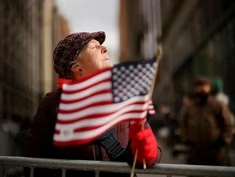
David Baldacci and wife work to counter toxic discourse
Video has Closed Captions
Clip: 12/24/2025 | 8m 23s | How author David Baldacci and his wife are working to counter toxic political discourse (8m 23s)

'Joy to the World' performed by U.S. armed forces musicians
Video has Closed Captions
Clip: 12/24/2025 | 3m 32s | 'Joy to the World' performed by U.S. armed forces musicians (3m 32s)

Local communities may hold the answers to national divisions
Video has Closed Captions
Clip: 12/24/2025 | 10m 15s | Why local communities may hold the answers to national political divisions (10m 15s)

News Wrap: DOJ says more Epstein documents discovered
Video has Closed Captions
Clip: 12/24/2025 | 4m 33s | News Wrap: DOJ says over a million more Epstein documents discovered (4m 33s)

Palestinians mark Christmas in Bethlehem amid conflict
Video has Closed Captions
Clip: 12/24/2025 | 6m 42s | Palestinians mark Christmas in Bethlehem while navigating life during conflict (6m 42s)

Why Christmas carols endure as popular music changes
Video has Closed Captions
Clip: 12/24/2025 | 7m 27s | Why Christmas carols endure as popular music changes (7m 27s)

Zelenskyy proposal for Russian-occupied areas of Ukraine
Video has Closed Captions
Clip: 12/24/2025 | 4m 36s | Zelenskyy proposes compromise for Russian-occupied areas of Ukraine (4m 36s)
Providing Support for PBS.org
Learn Moreabout PBS online sponsorship
- News and Public Affairs

FRONTLINE is investigative journalism that questions, explains and changes our world.

- News and Public Affairs

Amanpour and Company features conversations with leaders and decision makers.










Support for PBS provided by:
Major corporate funding for the PBS News Hour is provided by BDO, BNSF, Consumer Cellular, American Cruise Lines, and Raymond James. Funding for the PBS NewsHour Weekend is provided by...