
Bigger Corn Yield Pressures Grain; Local Food Reaches School Lunch Trays
Season 52 Episode 5208 | 26m 45sVideo has Closed Captions
Higher USDA yields pressure grain. Plus, opportunities/costs of putting local food on school trays.
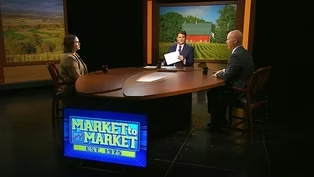
USDA raised corn and soybean yield estimates above trade expectations, sending grain futures sharply lower. Ahead of National School Lunch Week, one Iowa district shows how local farms and food hubs are helping supply school cafeterias — and the costs and logistics involved. Naomi Blohm and Ted Seifried break down the report and what it means for grain markets.
Problems playing video? | Closed Captioning Feedback
Problems playing video? | Closed Captioning Feedback
Market to Market is a local public television program presented by Iowa PBS
Bigger Corn Yield Pressures Grain; Local Food Reaches School Lunch Trays
Season 52 Episode 5208 | 26m 45sVideo has Closed Captions
USDA raised corn and soybean yield estimates above trade expectations, sending grain futures sharply lower. Ahead of National School Lunch Week, one Iowa district shows how local farms and food hubs are helping supply school cafeterias — and the costs and logistics involved. Naomi Blohm and Ted Seifried break down the report and what it means for grain markets.
Problems playing video? | Closed Captioning Feedback
Where to Watch Market to Market
Market to Market is available to stream on pbs.org and the PBS app.
Providing Support for PBS.org
Learn Moreabout PBS online sponsorshipComing up on Market to Market.
From farm to tray, getting locally grown food into school lunch rooms.
Report day as harvest hits full stride.
And double the commodity market analysis with Naomi Blohm and Ted Seifried, next.
♪♪ [ANNOUNCER] I wouldn't be here without my customers.
Yeah, I'd like to thank the customers.
They're very dear to our hearts.
It's about the people that you're working with and the relationships that you have.
Thank you.
Thank you.
Thank you.
Thank you from the bottom of my heart.
♪♪ [ANNOUNCER] Family owned and operated for more than 60 years.
Sukup Manufacturing is a full-service provider of grain handling, storage and drying equipment, helping farmers feed and fuel the world.
♪♪ [ANNOUNCER] Support for Market to Market has been provided by a bequest from Philip Lietz of Alta, Iowa, in recognition of public television's commitment to agricultural programing.
[ANNOUNCER] Market to Market is made possible in part by a grant from the Corporation for Public Broadcasting.
[ANNOUNCER] This is the Friday, October 9th edition of Market to Market, the Weekly Journal of Rural America.
[PAUL YEAGER] Hello, I'm Paul Yeager.
The first Atlantic hurricane of 2026 is bearing down on the Gulf Coast, with landfall expected Friday night or early Saturday in the Florida Panhandle.
In the grain belt, harvest has finally found a dry stretch.
Well, that was until overnight rains reached from Iowa into Illinois.
Now, with Gulf energy production in the storm's path, fuel prices that touch everything from the farm to the plate are back in focus.
Next week is national school lunch week.
Schools serve nearly 30 million students a day, making them the largest restaurants in many communities.
Buying local can support area producers, but it often cost districts more in product and staff time.
One Iowa district has found a way to shorten the trip from farm to the lunch tray.
Here's David Miller.
All right, enjoy your lunch, guys.
[LAUGHTER] Thank you.
[LAUGHTER] Yes.
[NARRATOR] Kaitlyn Scheuermann is the dietitian and the farm to school coordinator for the Waukee Community School District.
Today, she's in a busy lunchroom at Waterford Elementary, a suburban school located just a few miles from Iowa's capital city of Des Moines.
For this lunch period, students are eating a locally sourced meal as part of Iowa Local Food Day.
This is an annual event where students eat food that comes from Iowa farms or operations just beyond the state's border.
[KAITLYN SCHEUERMANN] The procurement is definitely different around local foods.
We work with our food hubs a lot of times, but like we said, we also work directly with producers to diversify how we spend our money and how we follow our local USDA procurement guidelines.
[NARRATOR] Today, purchases of local food are 16% of the district's $2.56 million food budget.
On any given school day, more than 14,000 students can get a school lunch on this day.
Kitchen crews served over 8300 students across walkies, 19 buildings.
On the menu are nachos made with locally sourced ground beef, apples, salsa and cherry tomatoes from producers inside the state's borders.
Corn from just over the border in Minnesota.
Drinks include a regular lunch staple from the Iowa based Anderson Erickson Dairy, which provides milk for consumers in six states.
The farthest any of the raw ingredients traveled was about 245 miles, according to the National Center for Appropriate Technology, an organization focusing on sustainable agriculture.
The typical food item travels an average of 1500 miles.
Sharman says this isn't the only time.
Over the course of the nine month school year where locally sourced foods are on the menu.
She also offers a locally sourced item one day a month under the harvest of the month label.
A lot of planning relies on the use of local food hubs to aggregate the school's orders, according to the School Nutrition Association, nearly 30 million students eat school lunch every day.
In some cases, the school district is the largest restaurant in the area.
Amy Ahern, the district's director of nutrition services, says they aren't quite ready for local food day to be every.
[AMY A'HEARN] Maybe one day, once a week, there would be a local.
I can't promise you that.
It would be every day.
There is, yes, a handful of challenges.
Then there's procurement.
There would be a lot of stakeholders that would have to come together to be able to figure that out.
It's not a no.
It's just there would need to be a lot of things that would need to be figured out before we got to that point.
[NARRATOR] For Market to Market, I'm David Miller.
[ANNOUNCER] Next, the Market to Market report.
[YEAGER] USDA boosted yield for corn and beans.
Friday.
Sending the market lower post report.
Now for the trading week ending October 9th, the nearby wheat contract sold off $0.12 and the December corn contract lost $0.18 while being yield was up.
Stocks were listed bigger in the soy complex by USDA.
The November soybean contract gained $0.14 on the week, and December meal increased by 1810 per ton.
December cotton expanded $1.66 per hundredweight.
November class three milk futures went up by $0.50 per hundredweight.
The livestock complex was mixed.
December.
Cattle strengthened by five 57th November feeders put on 1080 and the December lean hog contract fell by 630.
In the currency markets, U.S.
Dollar Index gained 38 ticks.
November.
Crude oil gained $0.18 per barrel.
Comex gold added 56 $0.20 per ounce, and the Goldman Sachs Commodity Index was up nearly four points to settle at 74285.
Here now to lend us their insight on these and other trends, our regular market analysts, Naomi Blohm and Ted Seifried.
Hello.
[TED SEIFRIED] Hello.
[NAOMI BLOHM] Hi.
Hello.
[YEAGER] Quite a day, Naomi.
[BLOHM] Quite a day.
[YEAGER] So, this report, I don't always like to talk about what the expectations are, but this was a dramatic shift from those expectations, not just slightly different.
What was the headline for it that made it seem so different from the expectations?
[BLOHM] It was the increase in corn yields.
So, trade had been looking for a slight decrease in yield from the September report.
And we got an increase of nearly three bushels.
And it just doesn't jive with what we're hearing from clients.
We have been hearing average five year average less than last year.
20 bushels less than last year.
So, the USDA will fix it in January, I'm sure.
But until then this is the number that we have.
But it was a shock to the marketplace.
And so, we saw some fun liquidation.
But we did see buyers step up.
And I think it's impressive.
We didn't close limit down some bargain values here.
[YEAGER] We'll get into the buys part of this discussion in a minute.
But do you agree with Naomi's sentiment?
[SEIFRIED] Yeah absolutely.
I mean it was a big shock that, you know yield came in well above expectations.
There was a very wide range of guesses.
Some people had been looking for corn yields to be in the low 70s.
So, to come in the low 80s.
Wow.
That's the second largest yield we've ever seen.
The only compared to last year.
Second time we've seen a 180 plus like, wow, that's a, it's a big, big number.
And then on top of the higher beginning stocks.
So now you have a 1.85 billion bushel carryover in corn.
You know, just a month ago, we were talking about a 1.5.
So, stocks to usage went from, you know, that below that magical 10% mark to now almost at 12%.
So, you know, it takes a lot of wind out of the sails for corn.
Now, we did see some buying at the end of the day.
We bounced off that limit down.
I think you have a lot of people out there that are maybe not believing the USDA's numbers.
And I don't blame them because like you, all of our clients, not all of them, but you know, a lot of our clients are there's a theme presenting itself.
And that is corn is worse than I was expecting, maybe a lot worse than I was expecting.
Beans are better or a lot better than I was expecting.
Now, there's definitely some one-offs there.
But you know, the general theme is corn is worse than expected.
Beans are better than expected.
So, I don't know if this number holds up.
I'm not big on, oh, the USDA is, you know, trying to manipulate prices and things like that.
But I really do wonder if they have this one wrong.
Naomi.
And I hope we don't have to wait till January to find out.
[BLOHM] Yeah, I think I think you're right.
Maybe they'll make some adjustments next month.
And increase it a little bit.
But I feel like if you're an end user, if you are Mexico, if you are any country that needs to buy any grain, this was your chance to get it on sale for one more time.
It's extremely fair value here.
And I think you're going to still just see our demand continue to be strong going forward.
And we still have to get through, of course, South America and El Nino this winter.
So, I feel like we'll probably see prices trade in a sideways fashion where December corn may struggle to get back above $5 in the short term, but I don't feel like it can go too much lower because I just don't think that that yield is out there.
[SEIFRIED] Will this be the opportunity for China to come in and buy corn?
Right.
Crazier things have happened.
I don't really see China buying corn.
You look at the Chinese corn prices.
It doesn't really jive.
But this would give them, you know, if they're doing it for political reasons now they can do it cheaper.
Again.
Crazier things have happened.
It is a possibility.
And like you said, we have South America growing season.
We have super El Nino.
They look like use less fertilizer this year.
So is there going to be this big problem with the South American crop.
Is that going to bring more export business, business our way?
I think very much something I've been talking about a lot in the last couple of times we've talked is checking boxes, right.
The next big box to check would be that South American crop.
If there's issues there, we can see higher highs.
The problem is, is we're not at that point where we can check the box of a South American crop problem, weather problem that's still further on down.
So, I'm worried with the funds.
As of last Tuesday, still long, roughly 330,000 contracts of corn.
If they don't have the bullish fodder.
Today was not that day.
This report was not that report.
But if they don't have the bullish fodder and they decide to get out of a good, a good portion of that, we can have a deeper correction before we go and rally on a South American weather.
So, this is going to really test the technical damage that was done on Friday, is going to really test the fund's resolve on whether they're going to stay in those long positions or not.
[BLOHM] Good point.
[YEAGER] Do you have one contract, I mean, we've really been talking a lot of corn, but did you think that there was been overlord tones that were laid out in this report?
Was this one really only speaking to corn right now?
[SEIFRIED] I mean, corn was the big surprise.
That's what we traded.
You know, the way that soybeans came back and actually closed positive on the day, I think is really nice.
That's with a higher yield.
But you know ending stocks.
Still tight almost the same as last month.
I mean okay, just a little bit higher, you know, 350 million bushels.
I believe that's not a terribly bearish number.
It's not terribly bullish either.
But the idea that, you know, if there is a South American weather problem, it wouldn't take a whole lot more exports for beans to go on the balance sheet to make that that balance sheet shrink very quickly.
And stocks to usage for beans didn't change.
Still below the 7% mark.
So that is it's not wildly bullish, but it's not wildly bearish either.
[YEAGER] So in beans we'll bear down momentarily.
But was that a buying opportunity for beans as well today.
And did you think that was what maybe happened at the end of the session.
[BLOHM] Yeah.
I think that they did the November contract holding that 1275 support area is very important.
The $13 area will be the mark number.
That will be probably trading both sides of here in the short term.
But at the end of the day, when you have a small number of carryout like that, demand is still so strong for our beans.
And I got a little bit of information on the discoloration thing that's been happening across Nebraska and Iowa.
So, it's soybeans of other color, and it's an actual acronym.
And according to USDA for the one of their services, a few years ago, they said that they took out that it's okay to have soybeans of other color.
And it doesn't specifically qualify as a soybean number one or number two.
But where the problem comes in is if more than your load, like when we are exporting to other countries, if it's more than 10% of soybean of other color, then the person on the receiving end of the load can then decide if they want it or not.
If it then gets graded differently.
So, it could become an issue down the road.
[SEIFRIED] China rejecting cargoes.
[BLOHM] Yeah, that could be something.
But at the same time, you know, we still have strong demand and it's going to be one of those things.
Can we you know, like have the ADMs and the Cargills, now it's up to them to make sure they get it blended properly before it goes across the ocean.
[SEIFRIED] Yeah.
So blending is, is going to be thing, but it offers an opportunity for China to reject cargoes if they're buying for political reasons.
The cargoes come to them.
They have a reason to reject them.
They can get out of it and still say, we bought for political reasons, but the product wasn't what needed to hit our guidelines.
The other thing is demand had been strong, but it's really kind of slowed down lately.
We're not seeing these Chinese flash sales every day or every other day like we were.
And if we do, we get some unknowns in here of like 105,000 metric tons, not these big splashy numbers.
Our weekly export sales numbers have not have not been big and splashy.
The higher prices that we've had have since August have really kind of slowed things down.
So, you know, I think we have been feeling like China's going to buy that 25 million metric tons that I mean, to this point, they're almost 14 million metric tons into that.
So more than halfway, we had been feeling good about that.
But this recent slowdown, if that continues and you have if the trade starts doubting that they're going to get to that 25 million metric tons, that's when this this report becomes bearish because instead of adding to or potentially adding to exports, you might start taking away.
And in the fund's eyes, that's where that's when things go south.
So, I would really like to see these export sales, the daily flash sales, the weekly numbers pick back up again here in the next couple of weeks.
Otherwise, we might be in trouble.
[YEAGER] But did those beans go away because the summit's over to answer to point out what he's saying?
[BLOHM] Yeah.
Yes and no.
I think there China's waiting.
They're waiting for a little bit of a pullback on price.
The US dollar going higher has not been helpful.
I was just thinking that just in terms of the export market I think they're waiting for the price pullback.
And I feel like they'll come along here sooner than later.
And the USDA on the report today I think they increased crushed demand export demand for sure on the report, not crushed no.
So export demand on the report today.
So, they're still trying to have optimism that not only maybe China is buying, but someone else potentially.
So, it'll be interesting.
The next few weeks are important to watch the daily flash sales and the weekly export sales.
[SEIFRIED] So as far as that summit is concerned, obviously the optics during that summit, we got some pans, pandas out of the deal, which is a big thing for China.
Yeah.
But it is I mean -- [BLOHM] It is, it is, it is.
[SEIFRIED] It is a punch line.
But I mean, to China, it's not a punch line.
[YEAGER] I know.
[SEIFRIED] Right.
It's a very significant, very significant gesture from them.
Trump meeting Xi on the tarmac is a significant gesture from us.
Both sides said these meetings were great.
In the weeks that have followed, though, you start to hear some things.
Rumblings coming from China that maybe they didn't quite get what they were hoping for out of these meetings.
Maybe they're a little bit concerned or discontent with the meetings.
I think they wanted to focus more on us standing back or standing down from Taiwan and, you know, sorghum purchases have fallen off dramatically.
And I've got some of my cash traders that are telling me that they were they were told not to buy us sorghum right now.
And is that also happening in soybeans?
So, I don't know.
I think it is very important for us to see those sales come back.
And if they don't, then you have a market that starts doubting it again.
And if we're doubting that, that's when the funds really, I think, give up on, that's when we're testing the funds resolve right now, especially in corn.
But the funds keep defending soybeans.
If you take away the China, the China deals, you take away the Chinese purchases.
That's when I think the funds turn tail and say, okay, well, that trade's over with.
[YEAGER] So does that mean that UN checks those boxes for you?
[SEIFRIED] That starts to uncheck the boxes.
[YEAGER] Which is the opposite of what you're talking about.
Okay, we need to circle to wheat for a moment because we always talk about it.
But in the Black Sea region, you had some more headlines that in almost any other week would have been a major factor.
Again, the exports of Russia, the problems in Ukraine not going away.
Is the war premium still in on this wheat market?
[BLOHM] We don't have very much war premium at all right now.
The USDA acknowledged that Russia is exporting less.
So, on the balance books.
It's the five year low for what Russia has been exporting.
So, they're aware of the situation, but then they allow on the balance sheet other countries to pick up the slack that Russia would not be having.
So, it's interesting that the world right now is I think, that they're just taking it day by day.
So, they know that there's wheat out there.
We know that we're getting Russia and Ukraine to be able to export through different avenues than historically normal.
So, they're knowing that they're able to get product.
The issues would become if all of a sudden we have a weather issue with El Nino, and then we have another global wheat reduction.
So, we had the European crop lower, the US crop lower.
Now, if one more country around the world takes a hit, then you'll have a nice wheat rally.
But if there's something that happens with more Black sea disturbance where they really can't get the product out of these new avenues, then you have a reason to see the wheat market go higher.
But it just feels like it's a just taking the back seat for right now.
And have to just take it day by day.
[YEAGER] Technically, we're near the 100 day moving average.
Does that matter?
[SEIFRIED] Yeah.
Of course.
I mean, it's a big pivot point for the wheat.
The thing with wheat is that that wheat in Russia and Ukraine is there, right?
It will still be there.
If it doesn't ship now, it will ship later at some point.
That just becomes a bearish factor further on down the road.
And you look at our domestic balance sheet, the USDA just added bushels to that.
Now it's smaller than it was, has been the last couple of years or so.
But stocks are usually usage in wheat is still at 40%, right.
I mean we have domestically a whole lot of wheat.
We've not seen a big increase in our exports due to the Black Sea issues.
Our exports are, for lack of better term, kind of not great.
Like they they're not overachieving.
If anything, they're starting to underachieve.
And from a domestic standpoint, unless we get those exports, unless we have a reason to believe that our exports are going to be better than what the USDA said today, it's hard to justify an extended rally in wheat, even if there's issues going on in the rest of the world, because domestically we have the wheat.
We'd love to sell it, we'd love to.
We'd love to do more business in wheat.
We're just not getting it.
[YEAGER] Let's move to the dairy market.
If we could.
Yeah, 50 cent rally on the week continued the story of the heifers going into the general population.
What's the supply story impacting this price right now?
[BLOHM] So the story is still too much milk.
So, the most recent milk production report had milk production up 1.7%.
Now what we're noticing though, is that the milk production increases are decreasing.
So, they're slowly starting to come down.
But the theme of higher number milk cows continues the beef on dairy theme continues.
But what is interesting is that this summer they could get calves and they could price them out for about 1800 $1,900.
And I talked to a client in Wisconsin today and he said 1200.
So now it's the point where they're like, okay, this isn't as fun anymore because they're not just making money hand over fist.
And so, we're going to, I think, see, maybe the dairy industry now that it's not fun money anymore, we might start to see them call those older cows.
And then finally start to see that milk production come down.
But it's nothing that happens overnight.
It's going to take months, but of course, more milk production.
We have higher cheese production, extremely low cheese prices.
Butter prices are actually as low as they were nearly in Covid.
So, I'm going to actually stock up on butter before the holiday season and put it in my freezer, because it is so cheap right now.
But the shining star of the dairy market continues to be whey and powder, thanks to the protein demand.
So those are at near all-time highs.
So, it's a tale of two markets.
Class III milk futures suffering.
But we had some I think just technical buying and short covering buying.
But the class four market representative of the way in powder has been pretty darn good.
[YEAGER] Flip if you could to a you wrote in the newsletter that you've got a post coming out about the cattle market itself, as well as the feeders, and you have the story of the imports of feeders to this country and the impact.
But also, we're still dealing with plants, with workers and Ice involved.
And that's still hanging over.
What's the big story for you in the cattle market?
[BLOHM] It's a huge crossroads right now where we know that the herd is not growing, period.
It's not growing.
Imports, though, of fresh beef, are up 15%.
And that's probably going to grow into the end of the year.
So, there's measures being taken to try to bring these food prices down, bring the beef prices down.
But the herd isn't growing and the demand is still there.
So, it's a true crossroads where the cattle market today and feeders with the strong finish that they have, they are, I think, defending the six year uptrend that we've been in.
And so, it's going to be a fight to the finish of which side of this balance sheet and fundamental aspect finishes out.
[YEAGER] Is that how you see it, or do I need to pause for just another minute?
I'll pause for a moment there as we look at the November feeder chart here, Ted.
Technically, is this market starting to, as Naomi, starting to indicate, still trying to control things.
[SEIFRIED] We went through a period of time where we started to focus on the higher weights and the imports that we had coming in, offsetting some of the supply issues.
But now when we look at the last two cattle on feed reports, the placement numbers have not been picking up like they were last year seasonally, as they usually do.
So, as we look further on down the line, we still have this problem of not having the animals out there, and this is going to be actually be a bigger problem later on as we get into the winter months, into the spring.
So, the market's attention is now shifted back to that which has allowed us to really pick up off the lows.
And now when you have some pressure on the corn market, that's really allowing the feeder cattle to kind of get into their own.
And you've got a really nice technical setup in feeders now.
[YEAGER] Back to the original part of the program where there was a buying opportunity possibly today, hog market here again, opposite of everything.
[BLOHM] Yeah, December hogs had just been making new lows as the week went on.
And we have lower cut outs.
We have exports that are just kind of hum.
We're not seeing the demand there.
And so, it feels like the funds are just okay to be sellers.
They're pushing the sell button on the hog market, but we're at the point where it's getting, I think, undervalued.
And all we need is one headline just to make that market snap.
I always get nervous this time of year as we with disease with hogs and that kind of a thing.
And heading into winter, I just I remember that one year where it was truly an issue in Iowa.
And I get nervous about that.
I know that they do a great job of making sure that those things don't happen.
But hogs are undervalued.
I think that.
[SEIFRIED] But that would be very helpful.
[YEAGER] I wish we had more time and we'll continue that up in a minute.
Ted Seifried, thank you as always.
What a trooper right there at the end.
That was very good.
Naomi Blohm, thank you very much.
And thank you because you have been watching our market analysis.
If you are watching online or on the PBS app, we are going to stay right here, continue this discussion and Market Plus our online only segment.
Find it wherever you get your podcasts or at Markettomarket.org to watch, listen, or read our Monday delivered Market Insider is your chance to get news on this program.
First, the stories behind our stories, what our analysts say off camera, and special invitations to be part of the program.
Subscribe at Mar kettomarket.org.
Next week.
How one Western community is handling wild horses that have come to town.
Thank you so much for watching.
Have a great week.
♪♪ [ANNOUNCER] Market to market is a production of Iowa PBS, which is solely responsible for its content.
♪♪ [ANNOUNCER] I wouldn't be here without my customers.
Yeah, I'd like to thank the customers.
They're very dear to our hearts.
It's about the people that you're working with and the relationships that you have.
Thank you.
Thank you.
Thank you.
Thank you from the bottom of my heart.
♪♪ [ANNOUNCER] Family owned and operated for more than 60 years.
Sukup Manufacturing is a full-service provider of grain handling, storage and drying equipment, helping farmers feed and fuel the world.
♪♪ [ANNOUNCER] Support for Market to Market has been provided by a bequest from Philip Lietz of Alta, Iowa, in recognition of public television's commitment to agricultural programing.
[ANNOUNCER] Market to Market is made possible in part by a grant from the Corporation for Public Broadcasting.
 New
NewHow Corn and Soybean Prices Can Rally This Winter — USDA, China and El Niño
Video has Closed Captions
Clip: S52 Ep5208 | 15m 12s | How grain prices rally this winter w/Naomi Blohm & Ted Seifried on USDA, China demand & S. America. (15m 12s)
Providing Support for PBS.org
Learn Moreabout PBS online sponsorship New Episode
- News and Public Affairs

Top journalists deliver compelling original analysis of the hour's headlines.

- News and Public Affairs

FRONTLINE is investigative journalism that questions, explains and changes our world.

 New Episode
 New Episode
 New Episode

 New Episode


 New Season
 New Episode
Support for PBS provided by:
Market to Market is a local public television program presented by Iowa PBS