
August 7, 2026
8/7/2026 | 55m 41sVideo has Closed Captions
Sheldon Yett; Khalid Mustafa Medani; Yo-Yo Ma; Bryan Stevenson; Natasha Singer
UNICEF Sudan Country Director Sheldon Yett and Professor Khalid Mustafa Medani discuss the ongoing violence in the Sudanese civil war. Cellist Yo-Yo Ma and Bryan Stevenson of the Equal Justice Initiative on Ma's upcoming concert, reflecting on 250 years of the American experiment. New York Times tech reporter Natasha Singer shares her reporting on how schools are handling AI in the classroom.
Problems playing video? | Closed Captioning Feedback
Problems playing video? | Closed Captioning Feedback
August 7, 2026
8/7/2026 | 55m 41sVideo has Closed Captions
UNICEF Sudan Country Director Sheldon Yett and Professor Khalid Mustafa Medani discuss the ongoing violence in the Sudanese civil war. Cellist Yo-Yo Ma and Bryan Stevenson of the Equal Justice Initiative on Ma's upcoming concert, reflecting on 250 years of the American experiment. New York Times tech reporter Natasha Singer shares her reporting on how schools are handling AI in the classroom.
Problems playing video? | Closed Captioning Feedback
Where to Watch Amanpour and Company
Amanpour and Company is available to stream on pbs.org and the PBS app.
Watch Amanpour and Company on PBS
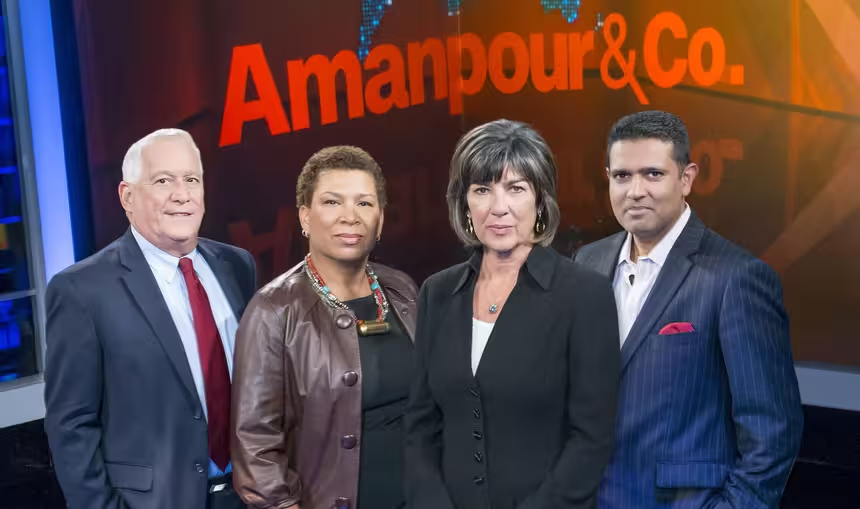
PBS and WNET, in collaboration with CNN, launched Amanpour and Company in September 2018. The series features wide-ranging, in-depth conversations with global thought leaders and cultural influencers on issues impacting the world each day, from politics, business, technology and arts, to science and sports.Providing Support for PBS.org
Learn Moreabout PBS online sponsorshipHello everyone and welcome to Amanpour & Co.
Here's what's coming up.
I've been doing this work for 30 years.
I haven't heard the collection of stories I hear in Sudan as frequently as I hear them here in Sudan anywhere else in the world.
No safe place to go.
As civilians in Sudan flee drone strikes, they risk famine, sexual violence and disease.
I speak to UNICEF's country director in Sudan, Sheldon Yett, and Sudanese scholar Khalid Mustafa Medani.
Then... There are more things that join us together as a species and with nature than divide us.
We the People, our shared past, present and future, an exploration of what it means to be American through music and performance.
My conversation with award-winning cellist Yo-Yo Ma and civil rights campaigner Bryan Stevenson.
Plus, the tech industry is framing AI as a magical, powerful tool.
And so if we're going to put this super powerful tool in schools, parents are rightly concerned.
What place does artificial intelligence have in our schools?
The New York Times technology reporter Natasha Singer speaks to Hari Sreenivasan about the use of chatbots in American classrooms and the backlash from parents.
Amanpour & Co.
is made possible by committed to bridging cultural differences in our communities.
And by contributions to your PBS station from viewers like you.
Thank you.
Welcome to the program, everyone.
I'm Bianna Goldriga in New York, sitting in for Christiane Amanpour.
We begin in Sudan, where after three bloody years of civil war, bombings, malnutrition and sexual violence are now widespread and getting worse.
On Sunday, a drone attack reportedly killed at least 35 people, according to a local rights organization.
The strike was conducted by the Sudanese army on a traditional community court in North Darfur, an area controlled by its rival, the Rapid Support Forces.
In recent weeks, thousands of people have been pouring into the city of El Obeid, attempting to find safety as the RSF forces advance, just to find themselves at the epicenter of the conflict once more.
Now, as the crisis deepens, humanitarian organizations across the board are pleading for assistance, many condemning what they see as a lack of international attention and action.
To discuss all of this, UNICEF's country director Sheldon Yett joined me from Port Sudan alongside Sudanese scholar Khalid Mustafa Madani in Cairo.
Sheldon and Khalid, thank you so much for taking the time to join us.
Really appreciate it.
Sheldon, let me begin with you.
You are joining us from Sudan, just back from El Obeid.
That is a city where hundreds of thousands of people, most of them women and children sadly, are caught between the Sudanese army and the paramilitary RSF force.
Tell us what you've seen.
Yeah, I mean the front lines continue to move there and it's very much a roller coaster.
The drone attacks that we saw on really a daily basis have died down for now, but I want to emphasize that they always start up and the attacks continue into the city and the routes on the outskirts of the city.
There are countless numbers of destroyed trucks, buildings.
The intensity of the attack is huge.
There are thousands of people who have moved out of the city.
They're going to displaced camps and moving into Khartoum, other cities around the country.
So massive numbers of people who have been displaced, massive numbers of people who need continued assistance, and massive insecurities continuing.
And as we know, sadly, this war has been ongoing now for some three years.
And Khalid, for viewers who are just now tuning in that haven't been following all of the latest developments, the Sudanese army has been fighting the paramilitary RSF now for a number of years.
The army just reopened the main highway into El Obeid, and yet the RSF's commander responded by ordering his fighters to "retreat no more."
Explain why this city matters so much to both sides, and what you make by the commander's order not to retreat.
Absolutely.
El Obaid is the capital of North Kodafan State.
It is absolutely strategically important city.
It's an important economic city.
That highway is crucial.
It is really the hub both of exports of agriculture, including gum Arabic.
Sudan exports the largest share of gum Arabic in the world.
It's also a strategic road in the sense that it opens up that highway between Al-Ubaid itself in Kurdufan, where much of the fighting is, and the capital city.
And so it's very important for commercial reasons, economic reasons, but the reason that the army has focused on it, and also the rapid support forces, is because it's extremely strategic, and it really is, it was really a city that required the army to try to break the seed and take it over, because it is really the front line to defend the capital city itself.
So on the side of the Sudan armed forces, this city, if it was not taken and if it is not, if the army does not continue to monopolize it, means that there is a good chance that the rapid support forces can take over the city, take over the highway and actually return to the capital city where the war began.
That's on the side of the Sudan On the side of the rapid support forces, the real kind of stronghold is Darfur, which it dominates and has dominated since at least late 2025 when they took over al-Fashr in the north.
And we spoke about that previously.
So holding on to al-Ubaid on the part of the RSF is a way not only to defend Darfur, their stronghold against the army, but also to try to actually go forward and try to retake the city.
And Hemmati or Mohamed Hamdan Degalo has announced in his speech that Khartoum is, believe it or not, once again a target and objective for them.
And if I could just follow up, Khalid, for the RSF, is their mission here, what is their ultimate goal?
Is it to win more territory or is the war itself their business model?
The war itself is a business model, but the statements of the rapid support forces, it's hard to believe given the atrocities committed by the rapid support forces.
but I would argue that's based on their statements over the years since the war started, is that they want to have a military kind of victory on the battlefield in order to engage in negotiations where they would have the upper hand, so to speak.
The same can be said about the Sudan Armed Forces.
While the rapid support forces continues to insist that their target now is still Khartoum, the capital city, this has to be understood in the context of negotiations.
The Quartet that was led by the United States, the Quintet led by the United Nations and other international bodies including the African Union.
So it's a war of positioning, so to speak, militarily.
I don't believe the rapid support forces believe that it can take over the entire country despite its statement.
But having said that, in this kind of jockeying for military control and territory, violence increases and escalates.
And we see that already in terms of what is happening not only in Al Ubaid, but throughout the region and in Kurdufan.
And now the rapid support forces, the leader has said that he's going to mobilize tribal allegiances or tribal groups and has stated that he's giving them free reign to commit atrocities at will in order to fight back against the Sudan Armed Forces.
And that is just horrifying to hear, especially given all of the reports of the mass atrocities that we've been covering now that civilians have been forced to endure for three years.
Sheldon, let's talk about that.
More than 330 children reportedly killed or maimed across Sudan in just the first six months of this war.
You've spoken with children, like 13-year-old Nuha.
She hid under a bed with her hands covering her ears during the bombing.
She didn't know where her parents were.
I mean, that's just one example.
Just tell us more about your encounters with these children, your reporting that you've heard from others about the impact this war has had on children and families.
Yeah, Nuha explained what it was like there.
She heard explosions all around her.
Her family left.
She still can't find her father.
Her story is very typical of stories we heard from other children, other women there.
Many have had to flee.
I had to flee without all their family members or having family members getting lost on the way or dying on the way.
I spoke with one mother who lost a daughter who just died.
Just the stress of walking in the heat.
It's now over 100 degrees here in Sudan on a daily basis here.
There's limited water.
There's limited sanitation, health services.
I spoke to many desperate mothers, desperate children, children who just wanted to go back to school, wanted to have the lives they had before the war began.
Many of the children I spoke to had been displaced multiple times.
The front lines in this conflict keep changing.
Communities often have to go from one state to the next as the front lines keep moving.
And as that happens, they often lose family members, lose contact with their family.
I have brothers and sisters die.
I heard countless numbers of those stories.
I heard stories of just blood curdling sexual violence as well.
When I was in Darfur, the stories I heard from from from mothers from children, after leaving al-Fasher, the same thing.
Lots of rape, lots of torture, lots of routine killing.
You know, I've been doing this work for 30 years.
I haven't heard the collection of stories I hear in Sudan as frequently as I hear them here in Sudan anywhere else in the world.
It is horrifying and Sheldon when you hear Khalid say the terrifying reporting that there are now tribes that are given carte blanche to commit more of these types of atrocities.
Just tell us your reaction to that and your concern about the impact that will have on the most vulnerable in the communities there women and children.
I think all of us at UNICEF and the broader humanitarian community worry about what will happen next.
How will we continue to deliver supplies to communities that desperately need them?
How will we ensure even the basic respect for international humanitarian law?
We continue to see our convoys being hit by drones.
We continue to see our staff being targeted.
We continue to see the communities in which we're serving being being attacked.
And we all worry that what is next.
What is essential is that children are able to go to school and ensure that schools are not being hit, that health centers are not being hit, not being looted.
And when you give that kind of carte blanche, when you see that kind of abandonment of international humanitarian law, it makes you really wonder, how do we prepare for this?
How do we ensure that we continue to work to get the supplies where they need to go?
And Khalid, of course, all of the warnings here are so loud and clear, and one just has to remember about the atrocities committed, what was described as hallmarks of genocide by the UN in al-Fasher, and 6,000 civilians killed in just three days' time, and one can understand why there's continued concern about the impact in other cities now, given some of the reporting.
You mentioned the peace plan perhaps on the table right now, that the United States is sort of taking the lead here, a 90-day truce, and then some talks.
The Army, however, says it will not sign off fully unless the RSF pulls out of every city that it's taken.
The RF welcomes this peace plan but it keeps on attacking.
The U.S.
envoy says the army chief has "apparently accepted the plan."
How do you interpret this?
Because it does seem very fluid and quite confusing.
I think that basically the army is the one that's most intransigent.
And that has increased, of course, after taking over or breaking the siege in Al Ubaid.
The general, Abdel Fattah al-Burhan, the head of the Sudan Armed Forces, the military, went down to the battlefield on the outskirts of Al Ubaid, the city, and he said, "We won't negotiate peace and we won't enter into negotiations."
But I do believe that that is very much a kind of a message that he's given to his rank and file and his supporters.
But nevertheless, behind closed doors and the back doors, like you said, there are talks ongoing, which I think is important.
However, the bar is very high on the part of the Sudan Armed Forces.
Basically, they are asking for the Rapid Support Forces militia to withdraw into camps and get out of the territories that they hold.
Now, that is, of course, very difficult.
Rarely does a ceasefire occur in that way.
It has to be negotiated, and then security sector reform is implemented in the context of negotiations.
And as positive as many have been with respect to the U.S.-led quartet, that includes, perhaps for your viewers who don't know, it includes the most important actors involved, which is, of course, the United States, the United Arab Emirates, Egypt, and Saudi Arabia.
The statement came out in September of last year.
Frankly, the events domestically, with respect to advances of the Sudan Armed Forces and the changes regionally with respect to the interests of Saudi Arabia vis-a-vis the war that's going on between the US and Iran.
That has slowed down the process and I have to say that it also has given a boost to the Sudan Armed Forces in terms of being more intransigent because Saudi Arabia has increasingly began to support the Sudan Armed Forces.
So the local aspect is really important in terms of the changes on the ground that are dynamic that have have really stalled these negotiations but I have to say given Sudan's location on the very important Red Sea that the external and regional aspects have also stalled because of the war.
Many changes are happening so it remains to be fluid but nevertheless I think that there are a number of people that continue to work towards negotiations and apply carrot and stick.
Yeah and the European Parliament we should note has named the United Arab Emirates as the RSS key arms supplier.
The UAE has continued to deny that accusation, the UAE a close ally of the United States as well.
So once again that coupled with the war in Iran and the crisis over the Strait of Hormuz and rising fertilizer and oil prices, all of this playing a factor into this war and perhaps prolonging it.
Sheldon, I do want to end with you because so many say that this and I believe Khalid as well would agree that this is not a forgotten war as much as it is a neglected one.
And we continue to see the focus on other wars around the world, whether it be Ukraine, whether it be in Iran, and we see that money, donations, going in for humanitarian aid in crises around the world continues to decline.
Just remind our viewers once again why it is so important not to neglect the Sudanese people here.
Yeah, there are 33 million people who are in desperate need of support.
We as UNICEF have only a fraction of the resources required.
And if we don't put resources into this war now, into addressing the humanitarian needs, into addressing the desperate needs of children, the needs will continue to grow.
I think we're really at the cusp of losing an entire generation.
Right now, there are some 8 million children out of school.
These children are at great risk of becoming child soldiers, becoming criminals themselves, doing all the things that children out of school don't want to see.
We need to make sure that the protective environment is there.
We need to make sure that populations get the support they require.
This is quickly becoming a regional crisis.
We know that it's bubbling over into neighboring states.
And if we don't pay attention now, I'm afraid it will only get worse.
I was here 20 years ago in Darfur, and you couldn't throw a stick without hitting a celebrity.
Now there's nobody to be found.
Nobody is really interested in this war.
Yes, as you quite rightly say, it's Gaza, it's Ukraine, and these wars, these conflicts matter.
These children in those countries matter, but we can't forget Sudan.
Children in Sudan matter, too.
Sheldon, Khalid, thank you so much for the time and for your investment in this very important story.
We appreciate it.
Thank you.
Now, what does it mean to be an American?
As the U.S.
celebrates its 250th anniversary, world-renowned cellist Yo-Yo Ma has been exploring that question through music.
In a week-long residency with the Boston Symphony Orchestra, the Chinese-American musician is hosting "We the People," a series of performances and conversations addressing the American experiment.
And during it, he took to a familiar stage, Tanglewood, where he has performed many times over the years.
[music] >> Now, this latest project was born out of a conversation Yo-Yo Ma had with legendary civil rights lawyer and founder of the Equal Justice Initiative, Bryan Stevenson.
And they both join me to discuss and share their reflections on America, past, present, and future.
Yo-Yo Ma, Bryan Stevenson, welcome to the program.
You're midweek in We the People, our shared past, present, and future.
This is a residency of concerts, conversations, and community gatherings with the Boston Symphony Orchestra.
Yo-Yo, where did this idea come from?
Well, actually, I was asked to think about how one might program a week of conversations and concerts with young people, with community, and I just thought, wow, what a privilege to be able to think about that while we're going through our 250th celebration and at a place that I love so much.
Since 43 years ago, I've been coming to Tanglewood, and I've always found this was a place that had a tradition of bringing community together, and everybody.
And so the "We the People" title came and says, "Okay, let's show it.
Let's see what our community looks like in the high school bands, in magicians, in storytellers, in musicians, and in country dancing."
You know, when people dance together, you actually -- that's the beginning of community.
Well, I'm sure that you would agree here about just bringing the community together.
Just tell me, Brian, about your involvement here and what you're hoping to accomplish.
>> Well, I do agree with Yo-Yo that music and art has a way of tearing down borders and boundaries and allowing people to see the beauty in one another, the humanity in one another.
And it's been such a privilege spending time with Yo-Yo, who's not only one of the world's most extraordinary musicians, but he's a humanitarian with a fantastic heart and a brilliant mind.
And so when he asked me to join, I was excited to do so.
He came to Montgomery last October and did an extraordinary event with us here at our Legacy Sites.
And then we were together in Davos to have a conversation with young people who were very focused on creating more peace in the world.
And so I think Yo-Yo has really built these extraordinary bridges between the arts and communities that allow everyone, no matter what their orientation, their level of interest, their skill, to participate.
And that's very exciting at a time when we are thinking about what democracy requires across the globe.
And Yo-Yo, you touched on the fact that you first came to Tanglewood some 43 years ago.
You're aging backwards, I have to say.
But you were there at the invitation of Seji Ozawa.
He is the former musical director for the Boston Symphony Orchestra.
Tell us about what it's like to be there at Tanglewood and your relationship with the venue.
Well, I was 28 years old and my son was just born.
And what happened was, as a younger musician, you're always surrounded by older people.
And Seiji asked me, "Would you coach young fellows at the Tangled Music Center?"
And so, and I did.
And what I discovered was a whole generation of people younger than me, fully formed, with ideas that were different from mine.
And I thought, "This is thrilling.
This is not a world just of older people and my peers, but there's a whole new generation that I need to discover and I've been discovering that ever since.
[music] You see, as an immigrant, one of the things that I've always tried to do was that I was interested more in what unites us than what divides us.
And I think what Brian's done in his life is that he's, I think, taken his idealism and then made it meet reality.
I think that's what music does.
We're very idealistic people.
We're looking for something that is ideal, like democracy.
And then you have to actually activate it.
And the activation is what happens at Tango.
It's when you bring the community together, when you bring different generations together, different wisdoms, and when they work and sit side by side, as you would see in this Beethoven Pastoral Symphony that's describing nature.
But working together like 80 people, like a flock of birds that could pivot and twist and turn on a dime without a visible leader, that to me is the magic of what successful democracy could look like.
And that becomes part of the American experiment.
Yeah, and as an immigrant myself to the United States, I share that same interest that focusing on what unites us here in this country.
And it's happening, as you noted, the United States is celebrating 250 years of its independence.
And, Brian, there was a lot of controversy surrounding how the 4th of July should be commemorated, about how history in this country should be framed.
President Trump ordered warning signs placed outside the Smithsonian's American History Museum, citing what his administration called "inaccurate information."
He calls efforts like yours, I should say, "ideological poison."
How do you respond to that, Brian?
Well, I don't think there's anything poisonous or unhealthy about just the truth of our history.
You don't have to be perfect to be something moving toward what can be better.
And I just feel like we have to have the courage to honestly confront our history.
Across the globe, there are places that have made tremendous progress.
In South Africa, if you go to Johannesburg, you see an apartheid museum that documents the horrors of apartheid.
And it was created so that people would not forget the pain and difficulty that that regime created.
In Germany, there are sites across Berlin that document the horrors of the Holocaust.
And I think that society has progressed because of its willingness to talk honestly about all of the pain and the trauma and the death and the violence that was created by the bigotry and the fear and anger that made that possible.
In Rwanda, not so long ago, there was horrific genocide where hundreds of thousands of people were killed.
I have tried to honor that, to acknowledge that, so that it doesn't happen again.
We have a country that has, as part of its history, some really painful parts.
The displacement of millions of indigenous peoples, the enslavement of 10 million black people over 246 years, a century of lynching and terror violence, segregation.
I was born at a time when I could not attend the public schools because of my race.
Black kids couldn't go to the public school.
But that changed because we were struggling together to create a more perfect union.
And our sites are really in service of creating that more perfect union by understanding the burdens that still weigh on us.
And so I think that truth and justice and truth and repair and truth and reconciliation and truth and restoration, truth and redemption, makes any community stronger, any community healthier.
When you go to the physician, you don't want the doctor to be banned from telling you if you have diabetes or high blood pressure.
You want the truth so you can then take the treatment that allows you to live.
And that's the way I think about history and culture and music because so much of the great music that you'll hear at Tanglewood comes out of times of conflict and difficulty and oppression.
Yo-Yo plays, you know, "Somewhere Over the Rainbow."
He plays music that was created in really painful, difficult circumstances.
And if you appreciate the circumstance, you can have an even deeper and greater appreciation of the beauty and the power of that music.
And Yo-Yo, Brian had earlier in the conversation mentioned the times that you've spent together both at his National Memorial for Peace and Justice in Montgomery.
I know you spent time together in Davos as well.
But for that visit in Montgomery, it is the country's first memorial to lynching victims.
What did that visit mean to you?
And can music actually carry history that is so painful, as Brian just laid out?
Well, Biana, I'm so glad you asked this question.
And I really want to say something to you and to Brian and to our audience that going to the memorial sites was actually one of the most important things I've ever done in my life in the sense that it changed my life.
It changed my view of things.
And to Brian's point of telling the truth, to your point of saying, "Well, what can music do?"
Well, it turns out that the memorial sites... Brian is a visionary artist to me, because by the time I went through the sites, it's not that I had more knowledge, more information.
We could get information from lots of places.
But I was left in a state of grace.
And by that I mean, at the end of that I was so overwhelmed, the way that we dealt, that Brian was able to deal with the truth, took it to another level, which I think is the level that music tries to do, is that it actually joins us together.
After seeing the memorial, I could talk to absolutely anybody about it.
And suddenly, it was no longer a secret that we're embarrassed about, but it's actually something we could share as a common history.
As an immigrant, I've always struggled with one thing.
I arrived in the United States in 1962, and I always asked myself the question, I arrived in the United States in 1962 and I always asked myself the question, "Am I a citizen of the country from the moment I became a citizen, from the moment I arrived, or am I actually responsible for the totality of our history of the land?"
And seeing the memorial sites, I was able to learn from Brian that this is the thing he taught me specifically, that there's been systemic changes in our society many times, but systemic changes can only change so much until we change the narrative.
And by building trust and by seeking truth together, we're actually serving one another.
We're serving the nature.
We become a better democracy and we can move on, as evidenced by what Brian has done in Montgomery.
And what we're trying to do here at Tanglewood is the same thing.
We're bringing people together so we are in a safe place to talk.
We're not challenging people.
We're not, we're actually creating a loving space where community feels that this is their place to enjoy, to partake in something much greater than us.
Brian, it must be so validating to hear how Yo-Yo reflects on his visit and the inspiration that it left with him to your museum.
Before we leave things, you mentioned Yo-Yo coming to this country at the age of seven.
You played the cello for a very long time, and Leonard Bernstein introduced you to America in 1962.
At the young age of seven, you were performing with your sister for President JFK during an American pageant of the arts.
And here is a clip from the Kennedy Center of that performance.
Welcome Yo-Yo Ma and Yu-Cheng Ma.
[applause] [music] Amazing.
Do you remember much at all from that performance, Yulia?
Well, Bienna, I don't know where you found this, but I have to say that as a seven-year-old, I knew President Kennedy and President Eisenhower were very important people, and they were there, and Leonard Bernstein, but the person that actually a seven-year-old was fascinated by was Danny Kaye, because he was conducting the National Symphony Orchestra, and he was so funny, and I thought I wanted to be like him when I grow up.
But what I do now know is that that event occurred within 12 months of my arriving in the United States.
JFK was my first president, and within a year after that, he was assassinated.
And so, that lives in my memory because I believed, and I still believe, in that power of that American dream, where we can actually make it possible to live together and to thrive together and succeed together.
But the destruction is always there also, just like in nature.
So I live with that.
That's my present memory of that event.
And I know that I look up to people like Brian to help me find a way to figure out who I am and how I fit in the world.
And I believe fully that as humans, as part of the species, there are more things that join us together as a species and with nature than divide us.
But that's a choice we need to make.
That's a choice I have to make every day.
Because as an immigrant, we know about two cultures always at the same time.
And that could be a disadvantage or it could be an advantage.
I would like to think of that as an advantage because it gives us more perspective and hopefully perspective leads us more to being able to find common truths and to build the trust that we need so that we can actually be of service to one another.
I couldn't agree more and as my parents say, we're not packing our bags ever again.
We're here, we came here, this country has given us so much and it's all encompassing and it's all about uniting and knowing our history and as Brian you say, what does it mean to be a great American?
That is the key question.
I'm wishing both of you so much luck with this residency and enjoy this weekend and I can't wait to hear all about it.
I only wish I could be there with you.
Thank you gentlemen so much.
Really appreciate this conversation.
My pleasure.
Thank you so much, Bjarne.
Thank you, Brian.
See you.
Now, hardly a day goes by without another headline about artificial intelligence and the fear surrounding how fast it's developing.
So what about the impact on kids in school?
Well, our next guest is a technology reporter for The New York Times, and she's been following how AI is being used in the classroom, particularly how American schools are now rushing to adopt chatbots that were once banned.
And while companies like Google, Microsoft, and OpenAI have been making assurances to educators, parents and teachers alike are concerned about the lack of guardrails.
Natasha Singer joins Hari Sreenivasan to discuss balancing AI literacy with safeguarding.
Biana, thanks.
Natasha Singer, thanks so much for joining us.
You are a New York Times reporter that has covered technology in the classroom for quite some time now.
And, you know, I wonder if there's something different about what's happening in the conversations that parents and teachers and students are having today versus previous cycles when laptops were introduced into schools or the Internet came in or social media.
Now, I mean, there seems to be a lot of focus around AI.
I think that's right.
And, you know, I've been covering tech in schools for The New York Times for more than a decade.
And we've seen some of these previous school tech cycles.
And I think they're important because I think they're actually one of the things that's behind this concern about AI.
So if you go back about 10, 15 years when companies like Microsoft and Google and Apple were saying, "Schools, if you just give every kid a Chromebook or an iPad, it will magically transform education and kids will learn valuable career skills," right?
And then they said, "Well, if you just give every kid access to YouTube and social media, it will revolutionize learning and they'll gain valuable career skills.
And then recently, if we just teach every kid to code, it will transform learning and give every child valuable career opportunities.
And so in this context, now we have Google and Microsoft and new players like OpenAI that makes chat GPT coming.
And they're saying something very familiar, which is, if we just teach every kid to use chatbots, it will transform learning and give them valuable career opportunities.
And the issue is the last few tech cycles didn't exactly pan out the way the tech industry promised.
And I think parents are much more wary this time with AI, partly because of these past cycles that didn't pan out and partly because the tech industry is framing AI as a magical, powerful tool.
And so if we're going to put this super powerful tool in schools, parents are rightly concerned.
One of the things they're concerned about, as you know, is that some of these chatbots have fueled industrial-scale student cheating.
And we're worried about the chatbots giving kids misinformation, and we're worried about kids forming relationships with chatbots.
And I think all of this is fueling a national discussion, like, what did we learn from social media?
What did we learn from this whole "give every child a laptop"?
Are we applying any of these lessons now?
The dream was every child can have an individualized tutor, and it came once in the form of software, and now it's coming in the form of AI.
Are those things working?
Have we seen the gains that we were kind of sold?
Well, again, if you go back a decade or so to tech industry and billionaires like Bill Gates were saying, like, big data will transform education.
And one of the things was, we'll have these personalized learning apps that have algorithms that can customize math or reading lessons to your child in real time.
And many of those did not pan out.
A few do have research showing gains.
But parents are also concerned about them because a lot of them have video game like engagement techniques.
And they have sounds and they have points and you can gain points if you like get the math problem right to customize your avatar and all these things.
And so I think one of the questions for parents is, is this edutainment?
Are kids really learning anything?
And I think now with AI, the promise and the marketing of an AI can customize what it's saying to each child at the right moment.
The promise is incredible, we would all love that to happen.
But what we're seeing is studies showing that the more you outsource your thinking, your research, your writing to an AI, you know, it's going to hinder kids from developing critical thinking, and it can impede learning.
And so, I think, again, you have parents saying, can't we test this first before we put it in every student's hands?
So it's not necessarily completely anti the technology.
What are the people here, let's say in New York or in other cities advocating for?
In New York, since you're there, you know, you've seen thousands of parents sign a petition asking for a pause on rolling out student facing AI tools.
And you've also seen the New York City Council, more than half of them sign a letter to the mayor and the superintendent urging multi year pause in other cities like Los Angeles and then with their national children's advocacy groups like Fair Play for Kids and Schools Beyond Screens and Smartphone-Free Childhood.
And what they're saying is they were advocating for a five-year moratorium on AI in schools.
And I think it's super complicated because first of all, the majority of high school students are already using AI in their own personal lives.
So are a lot of middle school students.
And I spend a lot of time talking to students about how they're using AI because I'm just interested.
Like, I think there's a false split between what kids are doing with AI in schools and what they're doing outside of schools.
And, you know, we all learn to use Google as our information retrieval system.
Well, teens are using AI.
They're bypassing the Google search and they're saying, "Chat, I'm out to lunch with my friends.
How many calories is this salad?
Chat, like, what is the capital of Mongolia?
Chat, can you explain to me how to make a birdhouse?
Chat, I'm going to, like, make a selfie in which I look like I'm a cyberpunk, you know, in an animated movie, right?
Like, it has become part of the fabric of their lives.
And so the notion that we should not teach students about this is also problematic because they're navigating an AI-fueled world.
And so I think what's going to be interesting is to see how schools and parents find a balance between making sure students can use these tools in ways that are effective and also having guardrails to make sure that some of the risks and harms of AI are going to be reduced, especially for kids.
You highlighted how two very different districts in the opposite sides of the country were dealing with technology and AI and how to implement it.
Yes.
I had visited Miami-Dade County Public Schools, and they were rolling out Google's Gemini for more than 100,000 high school students, all high school students.
And what was fascinating about that is, you know, you could have thought, oh, this is a Google-driven, you know, school project, but actually, you know, Miami-Dade County has a very sophisticated education technology department, and they decided to vet all the commercially available tools, the Microsoft tool and the Google tool and the OpenAI, AI and a few other ones, and really stress test them.
And so they spent months saying awful things to the chatbot to see what would happen, or trying to get them to produce answers.
And they concluded that Google was the best fit for their school system.
And then they trained more than 1000 teachers.
And I sat in on some of the trainings for teachers.
And teachers were in the beginning very gingerly trying out different ways of using Gemini.
And so I went to an English language arts class, where students were writing short essays about freewill and fate, you know, and in Oedipus Rex, do you know, do you have the ability to direct your fate?
Or is it chosen for you?
And they had to write just a very short, you know, few paragraphs.
And then the teacher asked them to put it into Gemini.
And Gemini gave them instant feedback.
And the feedback is not Oh, your writing is beautiful or problematic, or your vocabulary could be better, it was just is your thesis topic sound?
Are the examples you're using good enough to make your point?
And do you have a good enough concluding sentence?
Right?
So it was like, interim feedback to help the students who might be stuck.
And then they improved their work and handed it in to the teacher.
And then by contrast, as you know, Los Angeles Unified School District, which is the second largest school district, contracted with a startup to create a chatbot called Ed.
And LA Schools launched it with huge fanfare that Ed was going to be able to help students and direct them to the right resources and let parents talk to the chatbot and make sure that their kids were on track and so on.
But very quickly, it turned out that the AI startup was not really equipped to build this kind of thing for such a big school district.
There were questions raised about how it was handling students' personal information.
And then the Justice Department came in and charged the startup with defrauding investors.
And so it's quite a contrast because Los Angeles schools is the second largest school district, right?
And they could have used Gemini or Microsoft.
So why they went with a small startup that did not have a track record, you know, there's all kinds of questions and different folks are looking into it.
And so, you know, we don't know the answer to that.
But then we see Miami, which is the third largest school district going about this in a very methodical, careful way.
And so it's like the tale of two school districts going opposite directions.
You also have the federal government and the president going out and say, hey, listen, an executive order is out there already saying AI should be integrated across subjects.
We're going to prioritize federal funding for this.
And frankly, there's a huge chunk of our economy at this moment that's dependent on a handful of AI companies.
So I wonder, when you see that tension, how do the instructors on the ground, the students, the parents, how do they deal with that?
So I think at different times in the history of the United States, we've had different economic imperatives.
So AI is going to fuel our economy, and if we don't keep ahead, we are not going to be competitive globally.
And so you can understand the economic imperatives for wanting to have a trained workforce.
And you also have tech companies going around saying to teachers and schools like, "You must train kids for the AI-driven future.
You must train kids for the AI-first future."
And of course we want students to have career skills and to be able to go out and use the latest technology and use it in their jobs and their lives.
But I think the tension is that who's thinking about what's in the best interest of kids?
So I think the speed at which the industry is moving and wants kids to learn different things gives some schools whiplash.
And so if we think about what actually are the durable skills we want kids to learn, I'm seeing some schools think about AI literacy as a broad-based way of teaching kids and equipping them to be able to deal with any technology that comes down the pike.
I visited this charter school in New Jersey where two high school teachers saw that their 12th graders were all using AI, but they didn't know anything about it.
And they did not want the students to graduate without understanding that you're going to submit your resume and AI is going to read it, you may be rejected before a human ever sees your credentials.
And how are we going to operate in that world.
So they started AI literacy class in February, and I went to visit and it was just the beginning, and they pitched it to the students as a kind of AI driver's license.
They said to the students like, when you're in a car, you don't let the car steer you, you steer the car.
So we want to try to work out a way where you understand how AI works, and you're going to steer your own use of AI and make choices and not be steered by these tools.
And so the students did this whole audit of all the apps and AIs they used, and looked at when these tools were shaping them and steering them and saying, "Don't you want me also to look at this?"
And when they were making active choices.
And they had a kind of fascinating reaction to understanding how they had basically given away some of their autonomy to AI and they wanted to get it back.
There's another powerful lobby here when it comes to anything in the classroom, and that's the teachers unions, right?
And last year, we saw Randy Weingarten, who've been on the program before, the American Federation of Teachers, they partnered with Microsoft and OpenAI and Anthropic, and I think it was like a $23 million initiative called the National Academy for AI Instruction.
And yet now we see Randy Weingarten, her tone has changed, her opinion has changed on, you know, not just the adoption, but really how it needs to be rolled out.
So again, I think that this is kind of an incredible turnabout in such a short time, because last July, so last summer, the Teachers Union did do this $23 million deal with Microsoft and OpenAI to bankroll teacher training.
And Randy Weingarten said at the time, you know, we're not just going to teach teachers how to use these tools effectively, our teachers are going to have a seat at the table with OpenAI and Microsoft and Anthropic, and they're going to be able to weigh in on how these tools are developed for schools and how they're used.
And that was a rationale at the time.
And I sat in on one of those workshops, you know, the FT let me sit in, they were starting them in New York.
And teachers learned, you know, about privacy and security.
They also learned how to generate emails to parents and lesson plans and things with AI.
And then they use some tools like Suno, it's a song generating app, right?
So they generated like songs for different subjects as learning aids for the kids.
And I think it was really useful.
I think it was also, you know, very tool and machine focused, right?
All the kind of contextual things, and all the kind of hard questions you would want students to ask to think critically were not part of the workshops I sat in on.
And here we are less than a year later and Randy Weingarten gave a speech at the National Press Club saying that she thought AI was risky, that she was worried about kids safety, about them forming relationships with chatbots, about AI diminishing learning.
And she urged elementary schools to not use student facing AI at all for kids.
And so in less than a year, you have a transformation of somebody who was very enthusiastic about AI, and is still believes that teachers really need to master these tools, but now has deep concerns that you know, AI is the second coming of social media and could be risky.
When you talk to parents, have you found anyone that is well balanced in this?
That, you know, they on the one hand want their child not to be left behind if there's a huge technological wave that's coming.
And on the other hand, they also want to keep their kids safe and they want to make sure that they don't have weird relationships with chatbots and etc.
So, I mean, are there are there places that are doing it right?
And is there someone that's, you know, got a message that resonates with parents to be even healed about this?
I think that, you know, we have more than 13,000 school districts in the United States.
And as you pointed out, they're each doing their own thing.
And I think that parents are trying to navigate this, and I think one of the issues is these AI products are so new.
And we're seeing adults struggle with having relationships with chatbots and spending a lot of time on chatbots and outsourcing things to chatbots and feeling like their own critical thinking muscles are shrinking.
And so I think that we don't know what the impact of these powerful tools are going to be on schools.
And so when I talk to parents, some of them want there to be a moratorium on AI.
Some of them want their kids to learn these career skills.
And some, as you say, are trying to find a balance.
And they would like to see a kind of broad-based tech education that is not centered on industry products, but that is centered on students learning how these things work, how to use them, but also what the risks are, what the drawbacks are, and how to just ask questions about how tech is shaping us, what could be good for our communities, what we might not want.
And I think there's a beginning of that kind of broad-based movement, but also I just feel like the fight over AI is part of this larger conversation we've been having over education for centuries in the United States, which is what is the purpose of public schooling, right?
Is it to teach kids to be active citizens in a democracy and educated voters?
Is it to help them learn job skills?
Is it to help the prevailing most powerful industry of the day train their workers?
Is it to help students discover their passions, figure out who they want to be, what their moral code is, how they can help their communities?
And so what you think AI education should be depends on what you think the purpose of education should be.
But I think when I talk to many parents, they think the purpose is all of the above.
So how can we have AI education that satisfies all of the above?
Those are good questions to end on.
Natasha Singer, reporter at the New York Times.
Thanks so much for your time.
Thanks so much for having me.
And that's it for our program tonight.
If you want to find out what's coming up on the show each night, sign up for our newsletter at pbs.org/amanpour.
Thank you for watching Amanpour & Co on PBS.
Join us again tomorrow night.
(upbeat music)
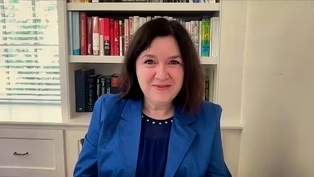
Schools Race to Keep Pace with AI in the Classroom
Video has Closed Captions
Natasha Singer discusses AI in schools. (17m 25s)
Providing Support for PBS.org
Learn Moreabout PBS online sponsorship New Episode
- News and Public Affairs

Top journalists deliver compelling original analysis of the hour's headlines.
 New Episode
- News and Public Affairs

Today's top journalists discuss Washington's current political events and public affairs.


 New Episode
 New Episode
 New Episode
 New Episode
 New Episode

 New Episode
 New Episode
Support for PBS provided by: